Wednesday, July 3, 2013

TREASURE OF THE FOUR CROWNS (1983)


“In the universe there are things man cannot hope to understand.
Powers he cannot hope to possess.
Forces he cannot hope to control.
The Four Crowns are such things.
Yet the search has begun. A Soldier of Fortune takes the first step.
He seeks a key that will unlock the power of The Four Crowns
and unleash a world where good and evil collide.”  
So decrees the Star Wars scroll opening of Treasure of the Four Crowns, just before it hits you with the scariest things the movie has to offer:  
Cannon Film Group.
A Golan-Globus Production.
Cue mind-shattering terror. 
I kid. I kid because I love. 
As soon as the titles are done rushing out at you, screaming “3-fucking-D!”, we are introduced to our hero, J.T. Striker, clad in his red satin jacket, lighting a cigarette against the wind, standing in front of a grand forced-perspective castle. Possibly Spanish. So far, we appear to be on an adventure with That ‘70s Show’s Bob Pinciotti, adventurer, outfitted by Jackie Chan’s Asian Hawk.  
Minutes later, he’s inside the castle, its interior transformed into a live-action Scooby-Doo set, and he’s immediately beset by vultures and rubber pterodactyls. Spears stab out of the walls, tunnel doors slam shut behind him. Ropes dangle over obvious trapdoors. A boa constructor lowers towards him. He grimaces in fear as it slithers over him. A guard dog chases him across crumbling edifaces, where it is joined by more friendly German Shepherds, tails wagging. He leaps through a glass window, runs past a bubbling volcanic cauldron, drops through a skylight, rolls down a tunnel, which conveniently explodes allowing him to do a daring flip over a pile of wood. While a skeleton and a suit of armor point at him courtesy of wires attached by phone linemen, he blows up an entombment and finally retrieves a key from inside a brass scepter. This, took, launches more booby traps, and wonks out the soundtrack, speeding up and slowing down ominous voices that bubble up from a dry ice cabinet. Nearly killed by a thrice-repeated shot of a fired spear, he’s then shot at by some laughing pottery and manages to dodge a spiked rolling pin swinging from the ceiling. And then come the fireballs (!), one of which he tries to catch. Finally comes the obligatory burning boulders—about the size of hefty pumpkins—that chase him around the room. The message here is to not concern yourself with all this precious archaeology.  During rape and pillage, temples have a way of shutting that all down.
Obviously, this is a very important key. Once he gets back to whatever he calls home, he stoically yells at his friend and partner, Ed, for not telling him how dangerous the place can be. As it turns out, the key fits one of the “legendary” four golden crowns forged by the Visigoths in the 6th Century, some time after their conquest of Spain. Inside they find a little scroll that says, basically, “The very existence of this scroll supports the legend.” Or, “The legend is true because I, the scroll, say so. QED.”
Now for the tricky part. Stryker is hired to put together a team to find the rest of the crowns, which lie deep within the bowels of The City of Love and Unity and the Temple of the Crowns. It’s the sorta-secret lair of “Brother Jonas” (aka Leo Green, from Brooklyn, who served a goodly amount of time in Sing Sing) who has begun his own religion. Has his own pig-mask-wearing Indoctrination Squad to round up willing (or not) Apostles and stuff them into his heavily-guarded mountain retreat. Brother Jonas says things like, “I want you to see what I see. Be what I am. And if you will not, then go to Hell!”
Edmond whips out a brilliant scale-model of of the fortress to plan the job. “For Jonas, the crowns are a source of destructive power. Weapons of fear. But I want to preserve that power for the future of mankind. They are part of an incredible legacy.” Only JT Stryker can pull off a job like this. So of course he refuses.
Until the very next scene where he and Edmond are shown recruiting a team. Let’s go to Video Junkie for a summary: “His team consists of an alcoholic electronics expert Rick (Jerry Lazarus), an over the hill circus strongman Socrates (Francisco Rabal), and his nimble and nubile daughter Liz (Ana Obregon). Also, Edmond (Gene Quintano), the operation’s liaison insists on tagging along to keep an eye on things and generally be a pain in the ass.” (“Scribbled” by Thomas T. Sueyres.) Rick describes them as “A tired old man, an inexperienced female and me, a guy with 90 proof courage.”
Mr. Sueyers also describes the Crowns’ potential: “They are believed to contain secrets of unimaginable power. So unimaginable that the five credited writers couldn’t come up with anything.” And let’s not forget to mention the very power of the stupid key! Without warning, the crazy thing will shoot out of Stryker’s hands, blow up crockery, knock over furniture and explode windows, letting all the snow in. The key can also create unmotivated red light. While it jiggles in JT’s hands, the others are attacked by lens flares.
As to be expected, the Crowns are protected by state-of-the-art technology and heavily-armed guards. Pressure-sensitive floors and walls, laser eye alarms, an intricate matrix of security the likes of which won’t be seen again until all the parodies of Mission: Impossible. 
Skipping the rest of anything resembling a second act, our insipid—sorry, intrepid—team has been air dropped onto the Citadel of Silliness. For the next twenty minutes, we’re actually treated to an actually tense and non-silly sequence involving the team rappelling across the ceiling beams, trapezing over the laser beams, electric fences and the pressurized floor. Sequence involves the occasional guard popping in for a spot-check during lots of dangling and trying to be quiet. The acrobatics in this sequence are actually worth your time.   
To break that up, we go behind-the-scenes with Brother Jonas as he collects chunks of Apostle hair to burn and help the Crowns heal a diseased “lost lamb” and bring her back into the fold. Part of the healing process has the masked guards rattle tambourines in the faces of the other cult members. Curiously, once the chanting and hysterics have passed, the little “lost lamb” winks at Brother Jonas and starts to peel off her facial wounds. Don’t get hung up on this as it’s never addressed again and the producers really wish you’d all stop bringing it up. 
Now, normally I wouldn’t do this, but I will now reveal to you the ending. Just the same, I promise you that I’m not giving anything away because, like the preceeding scenes, it doesn’t make a damned bit of sense. Swinging down from the beams, J.T. mounts this ugly blob of an idol--“Here I come, you magical son of a bitch.”—and uses the key to unlock the Crowns just as Brother Jonas and his guards burst in to spray bullets in random directions. The second he touches them, his head spins around like a malfunctioning Linda Blair doll and when it comes to rest, JT’s face is covered in lizard scales, cloudy eyes, and an even dopier expression than he’d worn at any previous point. He also becomes a subhuman flame thrower, spewing fire from the crystals he’d taken from the crowns and setting ablaze Jonas, his acolytes, his minions, his grunions and also his onions. Being special, Brother Jonas doesn’t just catch fire, but his skin falls off of his skull in little chunks at a time. Stryker is only changed back by Liz’s screams and sobs, which seem to be her specialty. Triumphantly, and with only the majority of his team dead, JT claims the Crowns, having more or less saved the day from evil. Or perhaps good. It’s hard to tell.
In in a final coda, a thrice-repeated shot of a snake-head bursting forth from a pulsing lump of goo, never glimpsed before in the film. Or since.
The best and most accurate review I’ve ever read of The Treasure of the Four Crowns comes from the wonderful website, KinderTrauma, and it goes like this: “[…] it’s mostly not boring.” And it’s impossible to argue with that assessment. If anything, the blessed few slow parts allow the viewer time to attempt comprehension of what he just witnessed. Please bear in mind that I have not come here to trash Treasure of the Four Crowns, for to do that would be like booing the Special Olympics. Honestly, this movie just doesn’t know any better.   
The team behind Treasure were more or less responsible for kicking off the brief 3-D boom of the early eighties with the reasonably enjoyable Spaghetti Western, Comin’ At Ya!. This golden era came to a head in 1983 with a Summer glut of poke-a-vision like Jaws 3D, Amityville 3D, Steve Guttenberg as The Man Who Wasn’t There, Spacehunter: Adventures in the Forbidden Zone, and Metalstorm: The [Non-] Destruction of Jared-Syn. (God, what a wonderful summer that was!) Because of the success of Comin’ At Ya!, Treasure was rushed into production by Canon using the same team of Tony Anthony, Gene Quintano and director Ferdinando Baldi. Conceived as a blatant rip-off of Raiders of the Lost Ark, the most Treasure had to boast was a score by none-other than Ennio Morricone who, judging by the laconic orchestration, must have done the composing at gun point.   
At the time of Comin’ At Ya!, Anthony (best-known to his schoolyard chums as Roger Pettito) was a familiar face to Spaghetti Western fans, largely due to his coincidental presence in Europe at the time of Sergio Leone’s world-wide success with the Dollars trilogy. Anthony starred as “The Stranger”, a shotgun-weilding anti-hero, in the moderately-successful A Stranger In Town, The Stranger Returns and The Silent Stranger, as well as a Zatoichi rip-off titled Blindman, which also starred Ringo Starr as a Mexican bandito. 
More interesting than the films themselves is the fact that Anthony achieved this by partnering with MGM stockholder and record producer Alan Klein. Klein is a notorious personality in ‘70s entertainment history for a number of reasons. For one, he re-negotiated a contract between The Beatles and EMI, garnering them higher royalties per records sold ($.69) and assisted George Harrison’s Apple Records financially by basically turning the company into a factory, complete with time clocks and an on-site kitchen, cancelling take-out meals and personal charge-accounts for the Beatles’ many hangers-on. He also assisted in the finishing of one of the most uncomfortable documentaries ever made, Let It Be, with help from future-murderer Phil Spector. In the end, as McCartney and Lennon chose to dissolve The Beatles (McCartney in particular disliked the producer and felt that the his cutthroat business methods were diminishing The Beatles’ legacy), Klein more or less successfully sued the band in what he called a “divorce”.
Perhaps more notatble, Klein was personally responsible for the long 30-year period of unavailabilty of Alejandro Jodorowski’s esoteric masterpieces, El Topo and The Holy Mountain. Persuaded by John Lennon to buy the rights to El Topo and bankroll Mountain, Klein intended to partner with Jodorowsky’s next film as well. Instead, after witnessing the financial success of “art pornography” like The Devil in Miss Jones and the infamous Deep Throat, he tried to persuade the avante guarde director to direct an adaptation of Pauline Réage's S&M bestseller The Story Of O. To Klein’s surprise (if no one else’s), Jodorowsky refused. Klein’s revenge was to withdraw all prints of El Topo and Holy Mountain from US distribution, denied all film festival requests for screening and reportedly flipped off the posters every morning before work (I may have made that last part up). This led to Jodorowsky’s public endorsement of any and all bootlegs of his films. It wasn’t until Klein gracefully died in 2009, that the director reconciled with the Klein heirs that the films were finally released to the eager public at Cannes and on gorgeous Blu-Ray.
But I digress. 
The point is, despite looking like the first guy to be rubbed out in any given gangster movie, and even after the world-wide failure of his final “Stranger” film, Get Mean in 1976, Tony Anthony’s star was still hovering above the horizon in the ‘80s thanks to Comin’ At Ya! But have no fear, Treasure of the Four Crowns put an end to all of that. But not for lack of trying.
As Roger Ebert wrote at the time: “It's fun to find a 3-D movie that doesn't beat around the bush. Within 60 seconds after Treasure of the Four Crowns begins, the movie is throwing things at the audience. This is, of course, in the great tradition of 3-D movies that began in 1953 with Bwana Devil" a horrible movie that made a lot of money by throwing stones, spears and elephants at the audience. You want to get your money's worth. […] In fact, with its cheerful high energy, Treasure of the Four Crowns may not only be the first of the 1983 3-D wave but one of the best.”
The sad fact of the matter is that, while Treasure was not a failure financially and went on to become an HBO staple (in 2D of course) for more than a year after, it suffered from the timing of its release. As popcorn movies go, it probably was a high point during that ridiculous summer. But when you get down to it, it was a gimmick movie, and a rip-off gimmick movie at that. By August, audiences had grown weary of having their eyes poked at, actors picking up tools for the sheer purpose of having things emerge from the screen (Treasure was particularly guilty of this, with more than one instance of one character handing a magnifying glass and the like to  another by waving it back and forth in front of the lens like SCTV’s Count Floyd), not to mention the intense migraines that came from having their rods and cones batted around for 90 minutes. 
The 3D “craze” continued sporadically through the summers of ’84 and ’85, the animated Starchaser: The Legend of Orin one of the final straws and then disappeared to obscurity. With no demand, Anthony and Baldi saw the cancelation of their own science-fiction follow-up (hinted at by Treasure’s non-sequiter coda), alternately known as Escape from Beyond and Seeing is Beliving. Baldi returned to Italy but Treasure basically marked the end of Anthony’s career, at least as far as acting goes. He did produce the Zalman King-directed Wild Orchid with Mickey Roarke, but mostly he concentrated on running an optics company, specializing in lenses that worked with the so-called “over-and-under” 3D technique. In 2009, he oversaw the transfer of Comin’ At Ya! to digital 3D and has hinted at giving similar attention to Treasure of the Four Crowns. 
Whether that’s a good thing or a bad thing is in the crossed-eyes of the beholder, but the timing seems perfect. What with the “immersion” use of 3D in modern-day blockbusters, it might actually be a nice change to have spears jump out at us once again, even if the wires do come with them.

Brain Dead (1990)


“How do we really know that we exist? What if we’re some sort of computer program, predestined to live out our lives in a certain way? How do we know if we’re awake or in some hyper-real dream and when we wake up, that will be ‘real life’?”
There are two types of people who frequently ask these questions: science fiction writers and people trying weed for the first time. Actually, the question of existence and reality is the fundament of most philosophies. How do we ever know what we’re experiencing is real. As Abraham Sofaer as “The Swami” put it in Head:
“We were speaking of belief. Beliefs and conditioning. All belief can be said to be the result of some conditioning. Thus the study of history is simply the study of one system of belief deposing another. And so on and so on. A psychologically tested belief of our time is that the central nervous system, which feeds its impulses directly to the brain, conscious and subconscious, is unable is unable to discern between the real and the vividly imagined experience. If there is a difference. And most of us believe there is. Am I being clear? For to examine these concepts requires tremendous energy and discipline. To experience the ‘now’ without preconception of belief. To allow the unknown to occur and to occur requires clarity. For where there is clarity there is no choice, and where there is choice there is misery. Then why should anyone listen to me? Why should I speak? For I know nothing!”
In the Julie (wife of Roger) Corman-produced Brain Dead (and not the alternative title to Peter Jackson’s Dead*Alive), Dr. Rex Martin (Bill Pullman) is a brilliant neurosurgeon studying the part of the brain that produces paranoia. He spends his days in a dim storage room (Number 8, the number constantly flipping upside down)surrounded by shelves upon shelves lined with human brains in glass jars, the kind you’d find in Young Frankenstein or The Man With Two Brains. His assistant treats these brains like office supplies, thinking little beyond the mess it makes when he happens to drop one. “People, Birkovich. Individuals. Minds, souls. Every brain is a living record of a journey taken,” Dr. Martin tells him. “Who knows what journey they’re on now?”
Martin’s new journey begins when he gets a visit from his old friend, Jim Reston (Bill Paxton), an executive climbing the ranks and upgrading suits. The company Reston works for, The Eunice Corporation, wants Martin to meet with and diagnose John Halsey (all hail Bud Cort), a mathematician institutionalized for murdering his entire family. Halsey created an elaborate mathematical formual that the Eunice Corporation desperately requires. The problem is that Halsey is so wracked with the paranoia that drove him to kill, the formula is locked away deep inside his mind. Indeed, Halsey has invented a false persona for himself in which he believes he is being persecuted by his “former boss” at Conklin Mattresses, who was having an affair with Halsey’s wife. Halsey believes that Conklin spied on him through money, “Instead of Ben Franklin I saw Conklin’s greasy face staring up at me.” His plastic wallet is filled with home made construction paper dollars, to fool Conklin and any of his agents still snooping around.
Returning to Reston, Martin is skeptical that he could do anything surgically to remove Halsey’s paranoia. “We can’t all do good, but at least do no harm.” Eunice Corp suggests an alternative then: cut into Halsey’s brain and destroy the formula, ensure that no one else can ever get at it. Martin balks at this as well. “It could be worse,” Reston tells him.” You could be the patient and Halsey could be the doctor.”
That afternoon, while walking to his car, carrying one of his favorite brains to work on at home, he is accosted by a raving homeless man who insists that the brain in the jar is his. Wrestling with the man and juggling the jar, Martin is suddenly hit by a car belonging to Conklin Mattresses, their slogan: “To Sleep, Perchance to Dream.”
Suffering only a mild concussion, Dr. Martin awakes from a bad dream in his own bed next to his wife, Dana (Desert Hearts’ Patricia Charbonneau) who he believes is having an affair with Reston. He makes the decision to operate on Halsey after all, and the next morning, before the entire board of the Eunice Company (including George Kennedy in a thankless cameo), behind two-way glass, he opens up Halsey’s head and starts poking around in the man’s brain.
Whatever visions plaguing Halsey almost immediately plague Martin. He finds himself pursued by a man in a bloody white coat (Nicholas Pryor, playing multiple roles here…or maybe just one), witnesses Reston having sex with his wife on their dining room table. Martin’s behavior changes. He’s often confused, dazed, speaking and acting inappropriately. Just the same, Reston approaches him with a brand new idea: custom lobotomies, cosmetic surgery for the brain, “kinder, gentler lobotomies”, to eliminate painful memories and bolster self-esteem without the cost of therapy. “Change their personalities, their very souls.” He even has a slogan, “The new you, from Eunice.”
The next morning, Dr. Martin wakes up in the Mayside Sanitarium, his doctor is the same man in the bloody coat who has been stalking him, and that somehow his own office has been moved to this building, and now houses the new doctor, who tells him that he’s been there for days. “We can be distracted by too much detail.” Martin is told that his psyche is shattered. He has projected Halsey to be his patient and himself Halsey’s doctor. Martin resists this explanation, insists that the office is his office and he knows who he is, insisting, “I have a Ph.D from Miskatonic University!”
Worse, Reston arrives, identified as the hospital’s accountant. Martin, too, is an accountant, the prize of Conklin Mattresses. Halsey visits him at his bedside at night and each visit ends in Martin waking up from a nightmare.
Halsey: “They told me the same stinking story. That you didn’t exist. That we’re the same person!”
Martin: “Didn’t we do this before?”
Halsey: “Are we doing this now?”
The pair pass in and out of each other’s subconscious minds, each insisting they’re part of the other’s dream. Each time a dream ends, Martin finds himself in a new location and a confused state of mind. People insist on calling him Halsey. The number 8 on his door has fallen again and again he spins it, stopping halfway to ∞. “No, I’m not dreaming,” he insists. “I’ve ruled that out. It’s like I’m being dreamed. Like we’re all being dreamed by Eunice.”
Before too long, it’s Martin in that chair, his brain exposed, and at the probe is not Halsey but the man in the bloody coat, Dr. Reston, aka Ed Conklin, owner of Conklin Mattresses, a partner with (or dummy name for) the Eunice Corporation. Martin repeats, “Just do no harm. No harm done.”
Originally scripted by Twilight Zone staple Charles Beaumont, Brain Dead is how Cronenberg would handle a slapstick comedy. The writer behind such classic episodes as “Long Live Walter Jameson” and “Shadow Play”, involving tricks of the mind, dreams and memory, Beaumont (aka Charles Leroy Nutt) wrote short stories for Amazing Stories and other pulp science-fiction magazines, he was also the first writer to publish a short story in Playboy. His original script for Brain Dead written (obviously) some time before his death in 1967, possibly around the same time he was writing for Corman and AIP, turning out the screenplays for Premature Burial (1962), The Haunted Palace (1963) and The Masque of the Red Death (1964) (as well as Burn, Witch, Burn (1961) and 7 Faces of Dr Lao (1964). So much was made out of this “new” Beaumont credit when Brain Dead was released in 1989 (in some markets as Paranoia), many fans apparently forgot that he was dead and saw this as his big comeback movie. “Big” being a relative term here, of course.
“The script was one that had been sitting around in Roger Corman’s possession for several years. It is rather amusing to picture Corman trying to get such a whacked out script off the ground in the days before [Nightmare on] Elm Street made this baffling reality flip type of film commonplace,” wrote Richard Scheib. “The final ending arrived at is amazingly bleak. While in another film all the reality bendings would collapse into meaninglessness, Brain Dead sustains them at such a dextrous series of whiplash reversals that it contrarily becomes thoroughly ingenious.” 
Brain Dead never saw much success. Released on VHS in the latter part of ’90 after playing a few late nights on HBO, it was finally dumped on DVD as part of “Roger Corman Presents: The Actor Series”, its cover showing a face stretched across a metal frame, taken from a visual non-sequitur in the beginning of the film. “The opening scene shows Dr. Martin’s assistant smiling gleefully as he wields what looks like a soldering iron above an exposed brain, connected by wires to a stretched, boneless face whose muscles the brain apparently controls. As the assistant shocks the brain in different areas, the eyes on the face turn to the left, then to the right, and finally go cross-eyed as the assistant titters to himself. Actually, this image of a grotesque, surgically removed face gone cross-eyed is a wonderful metaphor for a film whose cringe-worthy visuals are mitigated by a pervasive and singular humor.” (JonathanFoltz  ©2010 NotComing.com)
Over the years, it’s acquired a modest cult following, due to no little help from its confusion with Peter Jackson’s Braindead. Directed by (A Haunting in Conneticut screenwriter) Adam Simon, Beaumont’s posthumous movie offers a lot of mind teasing to make up for its utter lack of zombies. Aside from Foltz’s and Scheib’s reviews, it’s difficult to find a critic who doesn’t treat Brain Dead with condescension, if not outright disrespect. Much humor is to be found in the movie’s primitive effects (Cort’s open-brain prosthetic in no way resembles the actual brain-surgery footage projected in the board room during the first act surgery), and many have dismissed it as being “nonsensical”. However, as Foltz later writes, “Once the labyrinthine plot takes its initial turn, Brain Dead offers little consolation that it all makes sense, moving at a disorienting pace through realities and alternate realities. In fact there are so many scenes where Dr. Martin wakes up as from a dream that reality starts to lose its meaning, even for the viewer. This slippery, mise en abyme structure owes a debt to the script by Charles Beaumont, the legendary Twilight Zone writer whose life was cut short by disease. Indeed, Brain Dead’s contorted but campy brilliance feels like a faithful adaptation of the classic Twilight Zone aesthetic, but updated to be at once gorier and goofier.” [ibid]
Which still seems a little harsh. Maybe in these post-Matrix, post-Inception days Brain Dead has little to offer audiences who have become accustomed to dream logic narratives. But unlike modern mind-fuck movies, Brain Dead revels in its playfulness. Martin doesn’t chiropractically dodge bullets or rely on a spinning top to know when he’s awake, but wanders around in an uncomprehending daze of contradictory information, and the viewer is right there on his shoulders, looking for hints and clues amidst the film’s many details to figure out who, exactly—if anybody—is the sane party of the first part. If you decide that you did dig it the first time through, give it a second go and see if the movie changes your mind in whatever direction. It’s a fun movie filled with narrative close-up magic. And it has Bud Cort in it. Everything is better with Bud Cort.


Tuesday, July 2, 2013

THE BRAVE (1997)

"He could have, had he wanted to, cast himself as the Lone Ranger, and put a qualified, capable Native American actor ... of whom there are quite a few now, in the role of Tonto," said UCLA professor Hanay Geiogamah, a Kiowa tribe member. Once head of UCLA's American Indian Studies program, Geiogamah had been twice consulted by Disney for their previous Pocahontas animated features and was dismayed—along with many, many others—at Depp’s portrayal of the legendary Tonto in the Mouse’s redeaux of The Lone Ranger. From the actor’s speech patterns—"That sort of monosyllabic stuttering, uttering. Hollywood Indian-speak.”—to his borderline ridiculous appearance “inspired” by a painting Depp ran across on the internet, "We've got Johnny Depp with a taxidermied crow on top of his head and painted to the nth degree with paint, and he looks like a gothic freak.”

On the flip side of that, Depp was honored by Wallace Coffey, chairman of the Comanche Nation, and Santa Fe activist La Donna Harris adopted Depp as “an honorary son and member of the Comanche tribe.” Depp and Disney gave the proceeds from the movie’s world premiere to the American Indian College Fund. For his own part, it’s long been a dream of his to “fix” Tonto’s reputation as simply the Lone Ranger’s “sidekick” (though every incarnation of the story refers to Tonto as the masked man’s “faithful Indian companion”) by ensuring the Native was in all ways equal to his vigilante buddy.

So why the pidgin English? More importantly, why the bird on his head?

While we may never get proper answers to those questions, it all speaks to the actor’s long fascination of Native Americans, who we like to call “the guys who were here first.” “Asked if he's Native American, Depp says he grew up in Kentucky, where his great-grandmother and great-grandfather told him he had Cherokee blood. ‘But over there, could have been Cherokee, could have been Creek, could have been Choctaw,’ he says. ‘It was always something that I always felt very proud to have.’” (This quote and info above taken from NPR article, "Does Disney's Tonto Reinforce Stereotypes Or Overcome Them?" by Mandalit del Barco, July 02, 2013.)

Of course, Tonto is not the first Native American character Depp has tackled, but it will always be his best-known. For his first portrayal was that of Raphael, the poverty-stricken wet-brain of indistinct tribal origin who sells his life and body to a snuff film producer in exchange for a sum of money that will allow his family to survive. If this role doesn’t ring a bell for even die-hard Deppianados that can be excused. The Brave, based on Gregory MacDonald’s grim novel, was Depp’s directorial debut, notoriously booed at the Cannes Film Festival, prompting him to prevent its official release in the United States.

Best-known for the Fletch novels, MacDonald wrote the slim novel in 1991, where it received a decent audience and a notorious reputation for its third chapter, wherein McCarthy, the producer, describes in graphic detail what will happen to Raphael for the film. Two ex-wrestlers—“real monsters”—will strip him, beat him, tear out his fingernails, gouge out his eye, sever fingers and toes. It will be an hour of pain in exchange for a modest sum of money that, to Raphael, is a fortune. (The chapter, a challenge even for hardcore horror fans, prompted the author to issue a preface warning-slash-justification for its inclusion.) This is an act of ultimate desperation for Raphael. Hopelessly alcoholic, illiterate (he spells his name three different ways throughout the course of the book), at not-yet 21 he has a wife and three kids—without “knowing” how he got there—and lives with a community of junk-pickers who live on the outskirts of a city dump. They are unwanted by the dump owners, by the city, by everyone, and exist in a state of poverty that most of us can’t even comprehend. Checks “from the state” stopped coming because the man who delivered them stopped coming, or at least that’s how they understand it.

Yet, despondent and terrified, Raphael feels astonishingly emboldened with his “contract” and $200 advance from McCarthy. He has knowledge no one on Earth has: he knows exactly how and when he will die. And with this in mind, he spends the money and the remainder of his three days on Earth, trying to make things better, and more peaceful, for his family and community. Depp’s adaptation takes the central premise of the novel and takes a slightly different path towards the end. While the book is brutally straightforward, the film has a surreal quality to it, and an almost ethereal pace (which many critics found “leaden”, and from many standpoints it’s difficult to disagree). Depp’s Raphael still lives in a dump with his family and the many transients that make up their “tribe”. It’s still unclear what “kind” of Indian he is—even his father, played by Floyd “Red Crow” Westerman (who once recorded an album titled “Custer Died for Your Sins”) isn’t quite sure. Unlike his father in the book he doesn’t get offended, however, when asked. 

When not steadily framed on the plaintive Raphael watching the sun rise and fall, the camera constantly floats around the dump, focusing on the many odd details. The denizens of “Morgantown”, as they call the dump, appear more like survivors from an apocalypse. Grotesqueries abound. There’s a man walking around in a shredded tuxedo while pigs drink from baby pools. A father and son, Joe and Joe Jr. (Frederic Forrest and Max Perlich, seen at one point poking at the backend of a goat) have spent their lives drilling for oil. Like many other ancillary characters, Joe Jr. seems to have been plucked whole from Harmony Korine’s Gummo. There’s also the presence of Iggy Pop (who provided the score), so you know just how far this community has sunk.

Raphael’s wife, Rita, practically simple-minded and knowing no other life in the book, is worn to the bone in the film. She’s suspicious of the gifts Raphael brings and believes he’s returned to stealing, as are many of their neighbors. Morgantown’s sole big shot is a thief and a pimp named Luis (Luis Guzman, the one-stop shop actor when you need a vicious ethnic villain), who constantly blackmails Raphael, holding over his head some job they’d done in the past. And once Raphael is arrested and taken away, Rita will end up “working for him”. The invention of the Luis character, who is a strange composite of several novel characters ramped up for movie purposes, gives Raphael a sense of urgency. Luis is the danger that threatens his family’s chances of getting out of Morgantown once he’s paid for his services rendered.

The most glaring—and aggravating—change from novel to film has everything to do with Marlon Brando. Long having abandoned even the pretense of taking direction, Brando’s snuff producer McCarthy is a melancholy Baron Harkonnen here, wheelchair-bound and obese. He waxes philosophical about the upcoming film and is completely vague about what is to happen, or even what is happening at the moment. The McCarthy in the novel is an amoral but straightforward slug. “You look tough. You could stand an hour of pain, right? The more you can take, the better it’ll be. And you’ll be seen all over the world. You’ll be a movie star.”

Brando’s McCarthy weeps, is overcome by the beauty of what’s to come, and, in typical Brando style, is barely comprehensible during his meandering monologue. “What we have here is a little bit of shadow play,” he says, in between little blasts on a harmonica. “Maybe the more painful the death… it’s a sort of refinement. Pain is the completion of an equation. […] Childbirth is pain punctuated by joy. Watching a painful death can be a great inspiration to those who are not dying so that they can see how brave we can be when it’s time to go. It is the final measure of bravery to stand up to death in exquisite anguish.” Tears flow. “I’m sorry. But when death comes and pays us our final visit we can bid him welcome.”

In Depp’s hands—having rewritten the script with his brother, Don (billed as D.P. Depp) from Paul McCudden’s original adaptation—MacDonald’s very simple story, told from Raphael’s point of view but largely externalized and matter-of-fact—Raphael’s screen journey is turned inside. Depp is positively beautiful thanks to Vilko Filač and  Eugene D. Shlugleit’s photography. The camerawork is languid and works well with the patient editing scheme provided by Pascale Buba [by way of trivia, Buba is the brother of Romero editor and my own editing mentor, Tony Buba] and Hervé Schneid. In a sequence invented for the screen, the camera remains on Rita and the children, watching television in their trailer, while Raphael can be heard crashing around outside. When he urges them to come out, they discover that he’s built a little amusement park outside with scavenged materials and Christmas lights. The camera goes into an unbroken 180-degree pan across the various rides and games he’s constructed, and Raphael appears beside or astride each one, without a single cut (which means Depp raced around the camera for each appearance) but it’s a delightful shot, rife with love—Raphael for his children and Depp and company for the medium and the story they’re telling.

To build on that love, The Brave had a long and torturous journey to the screen. Paul McCudden licensed and adapted the novel and began shopping it around in 1993, finding a pair of first-time producers Charles Evans, Jr. and Carroll Kemp, who had just founded Acappella Pictures. They were captivated by the script and put together a package to make the film with a friend, USC film school stock room manager Aziz Ghazal. So strong was the story that the two fledglings were able to attract the attention of Disney’s Touchstone Pictures, despite their negative track record and Ghazal’s position as first-time director.

Just before filming was to begin in December, 1993, Ghazal murdered his three-year-old daughter, his estranged wife and then killed himself. His body wasn’t found until a month later. First-time director Touchstone could work with. Multiple murderers are harder to spin.

Finally, after already investing half-million dollars themselves into the project, Evans and Kemp managed to get it in front of Johnny Depp. Depp’s star was on the rise thanks to the successes of Edward Scissorhands and Don Juan DeMarco, and there was positive buzz about his titular role in Tim Burton’s upcoming biopic, Ed Wood, so he had some pull and he was garnering cred at an alarming rate. Unimpressed with the script, Depp loved the central message, “I liked the idea of sacrifice for family. And I kept thinking of things I'd like to add.” (The Sad, Strange Journey of Johnny Depp's 'The Brave', LA Times, May 19, 1997 by Mark Saylor.)

In addition to co-writing and directing, Depp also sank a reported $2 million of his own money into the picture. Seeking completion funds at the Cannes Film Festival, The Brave was met with the same polarized reactions that the festival is known for. Boos and accolades. European studios began a bidding war. U.S. studios just wanted to release “A Film By Johnny Depp” and every offer came with a proviso of steep changes. "I'm prepared to listen if there's a problem with length," Depp said, but rather than be forced to make changes, "I'll put it in a vault and let it sit." [ibid] In the end, The Brave played briefly overseas and Depp kept the U.S. rights to himself, basically refusing to allow it to be seen in his native land.

 
Because of the nature of humans and the subhuman nature of the press, this decision led to the urban legend that Depp had been “humiliated” at Cannes, that the reviews had been “overwhelmingly” negative and that he hid the film away out of shame. Which isn’t the case at all.
Yes, The Brave is slow. It’s multiple long shots of a wistful Depp/Raphael communicate a tendency towards vanity after a while, leaving quiet contemplation behind. It has some supremely bizarre moments and there are injections of noir that seem out of place, particularly those involving McCarthy’s right-hand man, Larry (played by “Hey, it’s that guy” Marshall Bell), who keeps popping in on Raphael to make sure he returns to the cavernous warehouse studio “on time and as promised”. But so many of the quiet moments with Depp and Elpidia Carrillo, who plays Rita, intensified by the gorgeous photography, make The Brave a worthy journey. If nothing else, it will take you on your own internal meditation, however briefly—would you do what Raphael agrees to in order to ensure a better life for your family? Do you love anyone enough to die, horribly, for their future?

Call it an art film or a think piece or whatever you want, but give it a shot before you dismiss it as a Johnny Depp vanity project. Especially these days, in the wake of his off-the-rails portrayals of Willy Wonka and Barnabas Collins, The Brave is a much-needed reminder of how good an actor Johnny Depp can actually be when he doesn’t let caricature get in the way. And don’t fret that the film has never received an “official” U.S. DVD release. It’s one of the easiest bootlegs to come by, all reproduced from overseas import prints.

Monday, July 1, 2013

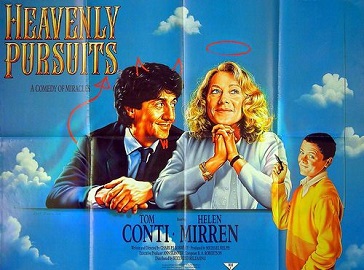
GOSPEL ACCORDING TO VIC (1986)


Also known as Heavenly Blessings, Gospel According to Vic tells a small story about a time-honored theme: that favorite teacher who succeeds simply by believing that his students are human beings, capable of learning if you find the right way to reach them. This teacher is usually at odds with the establishment—i.e. school administration—should be more than a little eccentric and more than enough inspiration to ralley his students at the end to go on to great things. Think of Dead Poets Society, Take the Lead, Dangerous Minds, Stand and Deliver, The Substitute, Class of 1984...
Now forget those movies because Gospel According to Vic isn’t like any of those movies. It’s far more subtler in both theme and storytelling and, if I might be so bold as to say it, better for all of that. It also stars the tragically-underrated Tom Conti as well as a young Helen Mirren, and those two things can only bring harmony to the universe.

Beginning in the Vatican, a young priest named Father Cobb (ubiquitous you-know-him-when-you-see-him actor, Brian Pettifer) is petitioning for the canonization of the Blessed Edith Semple, for whom his Scottish parochial school is named. While a nice old woman, she’s considered illegitimate for sainthood because her only vague miracle was performed in WWI. ''One nice little miracle - and then off,'' says the Vatican Mouthpiece. Everyone knows you need to perform three miracles to be considered a saint. Besides, the church has been downplaying the whole “miracle” thing since The Exorcist and penicillin. Disappointed but nonetheless resolved, Father Cobb returns to the school and leads a prayer service in the Blessed Edith’s honor, including in his invocation little Alice McKenzie, who is crippled.

Now we meet Vic Mathews, the irreverant non-believer who teaches remedial kids and is locked in an ongoing fight to keep one of his students, Stevie Dean, from being shuffled off to a “special school” due to his learning disabilities and disinterest in participation. In fact, most of his students require a specific touch to respond—one child has trouble reading and must follow along to Vic’s recordings of texts (“Turn the page, Robbie. I said turn the page, Robbie,” instructs one particular recording.), another can barely write his name and there are more than a few with emotional problems to boot. But Vic keeps them all engaged and motivated. When the class goes off-topic, he goes with them. When asked which language is “the hardest” to learn, Vic uses a comparative technique and has the class blurting out the names of different languages, and when Stevie Dean only half-listening pipes up with “Harley Davidson”, Vic continues in this vein, prompting the class in the direction of vehicle manufacturers. And running out of answers himself, he allows Stevie to win.

He’s also a champion of the childhood spirit. When, Ruth arrives, the new and very fetching music teacher, she catches a boy masturbating in her class. Vic is quick to defend the poor kid. “Look, there’s no problem,” Vic explains, and with a wink to Ruth. “I’ll just have a talk with him and instruct him to do it in private like the rest of us.”

“Do I look out of place?” he asks Ruth later, putting fingers up to his temples as horns. “Can you tell I’m a non-believer.”

One day after a visit to his sadistic dentist, Vic is waiting for a bus when he suddenly faints. The doctors send him home and once he’s gone, discuss among themselves the significance of the shadow on his x-ray crowning the top of skull. It won’t likely give him much time to live and since they’ve already sent him home, they decide there’s no point in telling him. That night, in an attempt to work his record player, he mumbles sarcastically to himself, “What we need here is a very minor miracle.” Suddenly, despite its not being plugged in, the player starts.

In the morning, he has a breakthrough with Stevie, teaching percentages by using the verbiage of off-track betting. Stevie grasps the idea of betting and returns in percentages immediately and, for once, not only participates but begins to explain the matter to the other students. However, Vic’s triumph is upstaged by the news that little Alice Mac has begun to walk again. In the evening, while trying to make friends with Ruth, he gets quite drunk, makes a series of inappropriate jokes about Alice’s mother setting up the whole miracle display, and manages to faint just before an offended “Wee Man in Pub” (as Jake D’Arcy is credited) socks him out. Ruth drives him home and, still giddy, he stomps on her gas pedal. They manage to make it all the way down the road without hitting a single red light.

“I feel I can help,” he tells her, referring to his students. “I feel I can help just by touching.”

Suddenly, the devout believer Ruth is in the curious position of trying to keep grounded the non-theist Vic. He’s discovering new ways to encourage his students to succeed every day and starts to believe that, perhaps, he is gifted. During a parent conference, Vic discovers that one of his boys is trapped on a high roof. Leaping from one roof to the other to save him, both the boy and Vic fall four stories and survive—the boy maintaining a few fractures and Vic lands with barely a scratch. Even better, his x-rays return minus the ominous shadow. Discussing this with Father Cobb who off-handedly calls the event a miracle, the doctor replies “Are you telling me that a man falls forty feet and only bangs himself up enough to cure his incurable cancer? Could set the whole of medical science back to the Dark Ages! You don’t need hospital, just miracles!”

Newspaper reports of “Miracle Teacher” set Vic’s teeth on edge and makes things worse for the school. The Headmaster quietly moves Stevie Dean to the special school of his and almost immediately removes another student from his charge for accidentally speaking to a reporter. Vic doesn’t care for this and doesn’t care for the extra attention he’s receiving from Father Cobb, going so far as to confront him during Holy Communion “I don’t want your prayers. You want to pray for someone, pray for the boy in the hospital. You’re not going to make a miracle man out of me!”
It would seem that Vic’s sudden survival is causing him a reverse crisis of faith. He’s invested so much in being an atheist that he doesn’t want to believe in miracles, but as a practical man he’s finding it difficult to shrug off everything as co-incidence. So begins his tightrope walk between glory and ego. “It wasn’t the Blessed Edith that got Steavie Deans off the hook,” he tells his union rep and friend, Jeff Jeffires. “It was me, and I’m no miracle man. I’m a teacher.”

The conclusions he, Ruth, the headmaster, Father Cobb, et al, come to are—atypical for the movies—far from Earth-shattering in any sense of the term. In this world of Scottish quiet eccentric desperation, acceptance is just as miraculous as surviving a fall, which is to say, not very—or, to look at it from another angle, very. Who is really to say what a miracle is or isn’t? The Vatican can’t be bothered, Father Cobb looks for anything because of his love for the school’s namesake, while Vic and Ruth want nothing to do with the blasted things. Proof of God, Ruth explains casually, is in the ordinary.

Gospel According to Vic leaves the viewer not with halleluiahs but with simple affirmation that good people exist, even if they are at odds with what your personal beliefs are. The Headmaster (Dave Anderson) doesn’t have Stevie removed out of animosity towards Stevie or Vic, just actual concern for the boy’s well-being, bureaucratic as it might seem. Vic’s disbelief is not at odds with Ruth’s faith, nor Cobb’s devout calling. More than anything, the characters in Gospel According to Vic do little to antagonize each other as they just want to get through the day seeing one or more of their insular group in a crisis. Tom Conti may raise his voice both in and out of class, but this is very much a quiet movie, with “little” things to say. And ultimately, it says a lot. But ike Stevie and Robbie and the others in Vic’s class, don’t expect to be given the answers.

It’s no coincidence that writer/director Charles Gormley’s movie brings to mind the gentle humanist quality of the comedies of fellow Scot Bill Forsyth. The latter gentleman behind such understated movies as Gregory’s Girl and Local Hero was and is a good friend to Gormley, and his staunch belief in human nature seems to have rubbed off on Vic’s director. Gormley’s every touch from script to screen has been light, guiding rather than nudging. No better proof of this can be found than in both Conti’s and Mirren’s performances. As Vic, Conti embodies the nice-guy-smart-ass teacher in the most likable way possible. And his Vic isn’t disdainful of those of faith, but is playful with the concepts. As he and Ruth get romantic on a desk in a newspaper morgue, Vic asks, “If there are saints watching us, do you think they’ll be able to see us okay with the lights off? Wouldn’t want to spoil their fun.”

Now for the inevitable tragedy of Gospel According to Vic: except for a stripped down Region 2 DVD, there’s been no home video release since its original VHS. It didn’t even play on HBO for long in the ‘80s, whereas Gregory’s Girl could be counted on to pop up every other month or so. And that should bring a tear to film lovers because you don’t come across a movie like this that often. At the risk of being precious, stumbling over a Gospel According to Vic can be a miracle in and of itself.


[By the way, the name “Blessed Edith Semple” led me on a snipe hunt to draw some parallel to famous radio evangelist and reported faith healer, Sister Aimee Semple, who I first heard mentioned in Jim Carroll’s song “Catholic Boy”, off the album of the same name. I’ve come to the conclusion, given the sparce details on “Blessed Edith” and the vast amount of information given Sister Aimee, that Gormley just liked the name.]


BRITANNIA HOSPITAL (1982)


A running gag on Spike Milligan’s sketch shows involved a patient visiting a doctor’s office. The doctor would ask, “Will this be on the National Health or private insurance?”
Patient: “Oh, private insurance.”

Doctor: “Right.” Then he’d flip down the flag on a taxi meter and let it run.

Now Americans, of course, don’t have this option. If we were to say “National Health”, a conservative clown car would drive up and heave us right out of there. In Great Britain (and the majority of Europe, Asia, Japan, China, Russia, Canada and far-flung Greenland) the state takes charge of its citizens’ medical needs. If you can’t afford fancy “private insurance”, well the hospitals will care for your tired carcass regardless. It’s a working system, not however without its flaws, as with any system. The main difference between, say Great Britain and America, is that ol’ Blighty won’t let you die of the plague just because you’re penniless. If you die, it’ll be due to something else. Probably unrelated.

By Lindsay Anderson’s own admission: “Britannia Hospital (as my picture is called) is the usual over-ambitious conception, satirical, ominous and absurd – designed to annoy practically everyone.” (LA/1/9/3/5/10, Lindsay Anderson writing to Pauline Melville, 31/07/1981, The Lindsay Anderson Collection, University of Stirling.) (Unless indicated, all quotes taken from Participations, Journal of Audience & Reception Studies, Walking the talk: reflections on Indigenous media audience research methods, by Kathryn Mackenzie and Karl Magee, Stirling University, UK Volume 6, Issue 2 (November 2009). If that designation was sincere, then in 1982 Anderson definitely succeeded. According to Brit critic David Robinson, “…no major British film can ever have suffered so calamitous a debut” (David Robinson, ‘Time to reconsider a masterly vision’, The Times, 15/10/1982.), and not because the movie was seen as an unsatisfactory wrap-up of the so-called “Mick Travis Trilogy” Anderson had begun when he cast Malcolm McDowell in …If and its ambitious follow-up (co-written by McDowell), O Lucky Man.

In the Autumn of 1982, the United Kingdom and its people were under considerable stress. Unempolyment was at a record high, unseen since the ‘30s, and to top that a large number of union worker strikes broke out throughout the island. Add to that the controversial war raging in the Falklands and increasing IRA-attributed terrorist strikes, the upper-lips of all England were wilting. Hardly the best timing for a movie satirizing the nation’s health system, the monarchy, unions, class warfare, rising media chicanery and even Hammer Horrors. As Mackenzie and Magee wrote in “Participations”, “In the light of this social context it is hard to overstate the effect that negative reviews, and articles in which the film was portrayed as being ‘unpatriotic’, would have on the cinema-going public.” If the movie-going population hadn’t already dropped to another all-time low since 1972, the number of outraged might have been even greater. Barely publicized by EMI, Britannia Hospital was met with spectacularly negative reviews. And (ironically, considering the film’s primary McGuffin) with his Holiness the Pope John Paul II arriving in London that very weekend, few were keen on checking out what was being advertised as a high brow entry of the Carry On series.
The film’s set-up requires the entirety of its first act, but its tone is set during the credits. An ambulance drives slowly through the wrought-iron gates of the hospital estate, winding up a driveway choked with striking workers (including Robbie Coltrane) and angry protestors. The outrage is almost evenly split along two grievances—one involving the admittance of African despotic President Ngami, guilty of war crimes against his own people who has turned his own separate suite at the hospital into a mini-village filled with bodyguards, multiple relatives and even farm animals; the second and no-less angry mob consists of Britain’s working class who demand that the hospital discharge the wealthier “private insurance” patients who receive special treatment for their generous pocketbooks.

Joining this latter protest are the hospital’s union workers and supporters. The short kitchen staff refuse to make the special breakfasts and other meals for the upper class sickies. There’s also a matter of workers who are meant to get the hallway painted in time for the arrival of a “very special visitor”, but the paints don’t match and they’re waiting on supplies, “You may not believe it, sir, but we take pride in our work!” one says over his latest cup of tea.

Fighting through the crowds, two disinterested ambulance workers haul a dying man out of the back on a gurney, bumping and jarring him through the emergency room doors. Only a handful of late-night staff are present and none of them acknowledge the new arrival. It’s time for the drivers’ tea break and the head nurse is officially off duty. As they edge their way between the admit desk and the gurney, the neglected patient takes a final breath and dies, his arm dangling limp over the side. Two orderlies return to their card game.

Come the morning shift and things are no better. Mr. Biles (Brian Pettifer), Assistant to the Administrator, and Mr. Potter (Leonard Rossiter), Administrator, have to constantly negotiate to get anything done. Like the corpse on the gurney, for instance, blocking traffic. He gets back nothing but cheek. “Don’t you call us men. We’re staff.” To keep from running to the union, they’ll settle for double time, eggs, toast and sausage. Meanwhile, there’s the usual rigamarole in the kitchens. Union rep Ben Keating (Robin Askwith) insists on the rights of the staff and of the public patients. “It’s the same for everyone, or nothing at all!” This, of course, angers the Private patients who are outraged at the treatment. “For the amount you charge, matron, we expect more than a British rails box lunch.” And cite their years of service. “I drove a bus for 15 years to pay for this operation!”

To add to everyone’s pressures, “Her Royal Majesty (aka “HRM”) will be visiting in celebration of th Anniversary of the establishment of Britannia Hospital since its opening under Elizabeth I. Queen will be touring the facilitiesand the archways are still a shambles. Potter protests and a worker responds, “An insult to me is an insult to every unskilled worker in this hospital. Think upon that.” Within the hour, Potter is dogged by the ministers of etiquette, Sir Antony Mount (little person actor Marcus Powell) and  the Lady Felicity (John Bett in drag). Scotland Yard will have snipers on the grounds. Patients have been selected for presentation. “Nothing too gruesome, I hope,” twitters Lady Felicity.
the hospital’s 500

This very day also marks the grand opening of the Millar Centre for Advanced Surgical Science, named for its founder, a master of “experimental surgical Darwinism”, the sinister Dr. Millar (Graham Crowden, whom fans will recognize as the same sinister doctor who gave patients sheep legs in O Lucky Man). He eludes to his newest, greatest experiment, “Genesis”, and after greeting Dr. MacMillan (Jill Bennett) with a passionate but quite British kiss, they exchange a bit of dialogue regarding a new patient:

Millar: “How’s McReady doing?”

MacMillan: “Splendid, we’re expecting death within the hour.”

Millar: “I have high hopes for McReady.”

Unfortunately, McReady (a non-speaking cameo by Alan Bates) continues to linger. Taking advantage of the elsewhere chaos, Millar chooses to gently remove the patient from life support and sever his head with a laser saw. Also unfortunately, this act has been witnessed by TV journalist Mick Travis (McDowell), who has bribed a union window-washer to sneak him down the side of the building so he can spy with his state-of-the-art mini-camera. “Citizen of the world, that’s me. I started in coffee.” Mick’s inside man, such as she is, is Nurse Amanda Purcil (Marsha Hunt), who helps smuggle Mick into the Centre, has a go at him in a supply closet, then preps him for disguise as a doctor. Before long, they come to Dr. Millar’s personal storage room, containing banks of window freezers containing harvested body parts. Mick manages to move a torso from one freezer and hide there just in time to hear MacMillan report to Millar: “There’s a small problem with the left buttock. It will need to be replaced.”

Down on the street in the midst of a growing riot, Travis’ cameramen Red (Mark Hamill) and Sam (Frank Grimes), are far more interested in the medicinal offerings of the various countries they’ve visited and decide to try them all out at once, their backs to Mick’s camera feed.

Having already insulted the ministers of etiquette and embarrassed administration—sez Sir Geoffrey: “You’re not a doctor, you’re a vampire. To you Patients aren’t suffering beings to cure, but raw material for your egomania.”—Millar has little interest in the Important Visit save for how it will affect his own presentation of “Man Remade”. His own documentary film crew is documenting his opening. To the cameras, Millar purees a brain to demonstrate the possibility of harnessing the full potential of 10 billion neurons. And then invites the director to take a swig.

Quickly—or, maybe, quicklier—negotiations, manipulations, protests and preparations have all whipped up quite a head of steam, with Potter and Biles bribing union heads with seats at the Royal Luncheon if they’ll co-operate outside of their own best interests, which turns out to be a rather simple solution to a complex problem. They also have to contend with the increasingly radical Anti-Ngami factions who threaten the safety of HRM and the Luncheon. Meanwhile, Travis is found out by Millar and his staff, but happens to possess a number of…items that Millar can utilize in his experiment. After much skullduggery, HRM arrives but so, at that very moment, to the riot police lose control of the protestors. For Dr. Millar, this all means a much larger—and captive—audience to witness his perfection, his “Genesis”.

There’s a lot of running around in Britannia Hospital and it is a bit of a satire smoothy—heavier-handed social commentary than If… and more slapstick than O Lucky Man, yet, somehow more accessible than either of Anderson’s previous entries. It doesn’t have a patience-trying running time, nor the cultural disparity of boarding school life to keep the audience at arm’s length. Many viewers have expressed disappointment that Travis is not the central character this time around and it is true that he tends to get lost in the chaos (until the wonderful set piece which I insist was inspired by Gordon Hessler’s Scream and Scream Again). There’s a lot to take in, a lot of characters to keep track of and a lot of rules to be acknowledged before they’re discarded. This isn’t the anarchy of Monty Python, but rather something akin to the daily cruelty of The Ruling Class. And despite the incomprehensibility of some of the Northern accents, Britannia Hospital manages to speak to cultures outside of Great Britain—really anywhere that contains a broken system of bureaucracy, government and public welfare.

“When it came to promoting Britannia Hospital outside the UK, Anderson was keen to stress that it was not a parochial work. In interviews and correspondence he repeatedly stresses that the themes of Britannia Hospital are universal and have relevance to all societies, not just Britain. This point was picked up by Alexander Walker (one of the few British critics who supported the film) in an article about its screening at the Cannes Film Festival in the Evening Standard in May 1982: ‘Its British setting in a London hospital, Anderson’s metaphor for a sick Britain suffering a nervous breakdown, hasn’t stopped practically every nationality present at Cannes from recognising and applying the truth of its savage comedy to the conditions of their own ailing countries’.”

With all the hooraw surrounding the derogatorily-named “Obamacare” and constant hysteria in the US, perhaps Britannia Hospital was ahead of its time and would be more warmly-welecomed now. In 1982, however, United Artists had less idea how to promote it than EMI in the UK. It had been ten years since the US release of O Lucky Man, and while it was met favorably by critics, it didn’t do tremendously well with American audiences. A superstar in Britain, Lindsay Anderson was far from a household name in the Colonies. UA’s trailers for the film were cut to make it appear a “zany” Python-esque romp, focusing on familiar faces like McDowell and Star Wars’ Hamill, who actually had a much smaller presence in the film than Malcolm. Anderson was “ashamed” of the strategies in his native land and was appalled by the obscene attempts at “blockbusterizing” Britannia Hospital abroad.

“I am quite ashamed to find that the general English-speaking hostility towards BH and the film’s dismissal by prejudice and resentment masquerading as criticism have disturbed me more deeply than is healthy. Not caused me to doubt the work, exactly, but made me aware of the near impossibility of getting across a point of view, values of reason and morality so alien to the spirit of our times. It is not so much the strength of the opposition that has discouraged me, as the lack of support, the indifference of the ‘uncommitted’ majority, and their willingness to be led by the enemy behind the typewriter … I have very little confidence that the film will do well. I don’t know whether it could have, given the benefit of a brilliantly intelligent campaign. But that is pure fantasy anyway.”

Britannia Hospital basically came and went. The US critics reviews were kinder to Anderson, perhaps due to Anglophilia towards the director, but it never found the correct audience. While it’s returned to the spotlight in recent years, thanks to McDowell’s praise of it in interviews and, particularly, on his one-man show about Anderson titled Never Apologize, Britannia Hospital remains, as Mackenzi and Magee observe, “perhaps the most unfairly neglected of his films.” Its lack of acceptance led to Anderson temporarily retiring from film, returning only to direct The Whales of August in 1987.

It is absolutely true that, in terms of it being a “Mick Travis” film, Britannia Hospital does not measure up to what came before. On its own, however, the movie is solid and often extremely funny. It also manages to be shocking even in this modern age of torture porn and endless war. Not only in terms of the Hammer-esque grand guignol climax of Millar’s “Man Remade” operation, but also in terms of corporate neglect, worker apathy, and the appaling conditions both staff and paitents face in modern hospitals (take, for example, the hospital’s Rudyard Kipling Wing, the most expensive, up-to-date, state-of-the-art, CCTV-covered ward, capable of housing 75 patients in complete comfort, but lays unused at the moment due to lack of cleaning staff). It’s also an example of how class warfare is alive and well in the 21st Century, even in the so-called “all men created equal” realm of the United States. As one placard in the crowd reads, “Priviledge is a crime!” Answering that, as the riot breaks free of the barracades and literally chases the Royal Family into Millar’s wing, Chief Inspector Johns declares that there’s only one thing left to do.

To which, Potter replies: Potter: “Cut the Luncheon!”

Without giving away the surprise (or, perhaps, lack-thereof) of what Millar’s “Genesis” is revealed to be, I’ll leave you with his final speech. What might have seemed heavy-handed in the ‘80s seems much more relevant today:

“Friends! Fellow Members of the Human Race! We are gathered here for a purpose. Let us look together at Mankind. What do we see? We see Mastery. What wonders Mankind can perform. He can cross the oceans and continents today, as easily as our grandfathers crossed the street. Tomorrow he will as easily cross the vast territories of space. He can make deserts fertile and plant cabbages on the Moon. And what does man choose? Alone among the creatures of this world, the Human Race chooses to annihilate itself. Since the last world conflict ended, there has not been one day in which Human Beings have not been slaughtering or wounding one another, in two-hundred and thirty different wars. And man breeds as recklessly as he lays waste. By the end of the century, the population of the world will have tripled. Two-thirds of our plant species will have been destroyed. 55% of the Animal Kingdom. And 70% of our mineral resources. Out of every hundred Human Beings now living, 80 will die without ever knowing what it feels like to be fully nourished... While a tiny minority indulge themselves in absurd and extravagant luxuries. A motion picture entertainer of North America will receive as much money in a month as would feed a starving South American tribe for a hundred years! We waste! We destroy! And, we cling like savages to our superstitions. We give power to leaders of State and Church as prejudiced and small-minded as ourselves, who squander our resources on instruments of destruction... While millions continue to suffer and go hungry, condemned forever to lives of ignorance and deprivation. And why is this? It is because mankind has denied Intelligence, the unique glory of our species - the Human Brain. Man is entering an era of infinite possibility, still imprisoned in a feeble, inefficient body... Still manacled by primitive notions of morality, which have no place in an Age of Science... Still powered by a brain that has hardly developed since the species emerged from the caves. Only a new intelligence can save Mankind! Only a new Human Being of pure brain can lead man forward into the new era. I do not speak of dreams. Such a being exists already. I have created it! It is here. Now. Prepare yourselves to meet the Human of the Future. Neither Man nor Woman. Greater than either. I have given it a name. Genesis. Birth. A New Birth. A New Beginning for Mankind. People of Today, Behold Your Future!”

Fill in the blank.


Wednesday, June 19, 2013

I BOUGHT A VAMPIRE MOTORCYCLE (1990)


Image stolen from UK Movie Posters

No film addict can survive on a steady diet of the same. You can watch Turner Classic Movies all day long but after such a marathon, you start to hunger for something different. Dare I say even something “worse”. “Worse”, of course, is subjective, so let’s say instead “ridiculous”. After a week of viewing heady and/or heavy movies, movies that made me think and feel, I was in dire need of the ridiculous. You can’t ask for more ridiculous than what is offered by the gory horror-spoof I Bought a Vampire Motorcycle. 
Director Dirk Campbell, very soon a maestro of children’s television programming, got hold of a script by Mycal Miller and John Wolskel (the latter a frequent writer of English-version anime like Appleseed), rang up half the cast (and sets and even the composer) of the BBC series Boon (including title character Michael Elphick, Neil Morrissey (future voice of Bob the Builder), Amanda Noar (aka Mrs. Morrissey, at the time, anyway), and C:3PO himself, Anthony Daniels. They gathered together and said, to borrow a quote from Daniels’ Priest character, “Right. Let's go kick some bottom!”

I would say that the film’s beginning—taking place in an old churchyard while a biker in a red hood that just screams “Satanist!” is obviously up to no good—with a turf war between two bike clubs, the unnamed Satanists and the vicious rabble “The Road Toads”, occurs for no good reason, but really, reason went out the window with the title. (In fact little happens in this film for any reason, so let’s just suspend that expectation altogether, shall we?) What happens is that The Road Toads lay brutal waste to the rival gang using crossbows and jump cuts. The hooded Satanist most near the center of the frame is cut down in the prime of his incantation, and the little animated Pokemon demon summoned has to quickly find a host. Its new home is the biker’s own abused Norton 850 Commando—as good as any in a pinch and, we’re told, a “quite reliable” vehicle. In a lovely scene, the dying biker-Satanist-guy slashes his throat and bleeds into the tank.

We then meet lovable slacker rascal Nick Oddy (Morrissey)—aka “Noddy”—who purchases the bike for £1100, tells his girlfriend Kim (Noar) he only spent £600, then calls his buddy Buzzer (Daniel Peacock) to take a butcher’s at it to see what it’ll need to make it go. As a gag, Buzzer steals the bike’s gas cap. The next day, he’s found strewn about his apartment (“That’s Buzzy. I’d know his head anywhere.”) but at least the bike runs perfectly now, so long as you don’t try to take it into the sunlight. Inspector Cleaver comes ‘round to make inquiries about who would have it in enough for Buzzer to dismantle him in such a way, but Noddy honestly can’t say. Partly because he doesn’t know and partly because Cleaver’s garlic breath has him momentarily stupified.
While out for a jag, Noddy informally meets The Road Toads and the bike bucks beneath him, running several of them, including their leader, Roach (Andrew Powell, Joshua Then and Now [review coming soon]), the crossbow-wielding mad lad-cum-teddy boy what done in the Satanist biker in the first place.

Later, they have a proper funeral for Buzzer, his coffin stuffed upright in some geezer’s sidecar. No hearse for Buzzer, “He wouldn’t be caught dead in one’a them things.” Noddy and Kim stop off for a pint and in walk Roach and his Road Toads. After a protracted brawl involving the entire pub, most of the crockery and several of the mock battle weapons decorating the walls, Noddy and Kim manage to escape on the bike. Still peckish, they swing by Fu King (ordering from none-other than Inspector Clousseu’s Cato (Burt Kwouk) for some Chinese, but the minute Kim suggests “garlic prawns” the bike takes off with her still on it. Around a corner, it tosses her off and seems about to front wheel her head off when the cross around her neck gleams and makes it back off.
Noddy finds Kim but the bike has gone out into the night to exact revenge on the rest of the Road Toads. First spikes grow out of its tank in punk porcupine fashion, used as both methods of impalation and projectile, then its cracked headlamp develops a chomping action rarely seen in motorcycles of that model. That’s not even to mention its Ben-Hur-styled arrowhead wheel protrusions. Only Roach escapes, albeit with a tie-rod lodged deep in his… er, tailpipe, as it were. Its bloodlust unsated, the motorcycle has a go at a woman Jack the Ripper-style in an alley. Then, just for fun, it eats a parking maid. This bit of greed gives it away. Unable to eat the whole woman, it returns to Noddy’s dark shed and that’s where its owner finds it, sleeping and with a support-hosed leg in its headlamp.

Understanding little of anything is a natural state for Noddy, so he goes off in search of a Vicar. Unfortunately, he has to make do with a Priest. 

 Image stolen from Flat Pack Film Festival

Noddy: “I don’t want to confess. It’s about my motorcycle.”

Priest: “Are you sure it isn’t a garage you want?”

Noddy: “My motorcycle has turned into a vampire!”

Priest: “Pull the other one.”

Soon the Priest understands what he’s up against when, whist attempting to haul the beast out into the sunlight, the clutch handle snaps his hand and severs his fingers. Now the problem arises: unless the Priest knows what demon he’s dealing with, any exorcism performed could just make things infinitely worse. And infinitely worse is what happens. The vampire motorcycle goes on an unprescendented maraude of slaughter and vehicular homicide, eventually trapping Noddy, Kim, the Priest and garlic-breathed Cleaver inside a gym for the chronically steroidal. And dawn is a long way off. Will Birmingham ever again be safe for the god-fearing members of the C. of E.? Or, okay, fine, the Catholics as well?

“And anyone involved in this project should be proud. The script is knowing and self deprecating, plus it doesn’t mind making Morrissey, the movie’s hero, out to be a lazy male-chauvinist pig. The British predilection with toilet humour is here in full force (the ‘talking turd’ sequence [a nightmare scene in which Buzzy embodies Noddy’s bowel movement] being a particularly disgusting highlight, especially when it jumps into Noddy’s mouth) as is our obsession with having nice cups of tea to solve everything. The music is also suitably ridiculous, ranging an incidental score that sounds like it was lifted from a Carry On movie (yes, they borrowed the composer from Boon, would you believe) to pumping rock tracks, one of which is called “She Runs On Blood... She Don't Run On Gasoline” (which is included in it’s separate entirety as a special feature on the DVD). But the biggest gem in this pot of treasure is seeing Anthony Daniels – Mr C-3PO himself – as a camp gung-ho biker exorcist, complete with razor-sharp throwing-crosses.” (Eatmybrains.com)

So, well… does this not summon to mind the word aforementioned: “ridiculous”? I Bought a Vampire Motorcycle is a gleefully gory horror-spoof-slash-homage. Never once does it take itself seriously because, well and again, it’s bloody title is “I Bought a Vampire Motorcycle”. If it were “Tea and Chips with the Missus”, that’d make it something else entirely. Everyone is on board here too, ‘all in’ as ‘they say’.

Truth be told, this was was a blind rental from our late-lamented local store, Incredibly Strange Video, sold by both the title and the prospect of watching His Lord and Lady Anthony Daniels perform sans gold outerwear. While not quite as hysterical as Braindead / Dead*Alive’s Father Jon McGruder (Stuart Devenie) (“I kick arse for the Lord!”), Daniels is highly entertaining and even kicks the film’s absurdity up another notch.

Speaking of the just-mentioned Peter Jackson cult favorite, there are numerous “touches” both movies share. Aside from the Priests and the anarchy, both possess comic relief bikers and a breakneck pace. Since they were released within a few years of each other (1990 for Motorcycle and 1993 for pre-LOTR Jackson), though from different areas of the English-speaking world, it wouldn’t be hard to imagine that both Jackson and Campbell hit on the same horror-spoof zeitgeist that drives both films. The biggest difference would be zombies vs. vampiric vehicles and a budget of $3 million versus whatever change was found inside the cushions in the Boon communal couch.

When you’re in need of ridiculous look no further. If ‘ridiculous is as ridiculous does’, then I Bought a Vampire Motorcycle does nicely.