Wednesday, October 31, 2012

DRAG ME TO HELL (2009)


Christine Brown, a mild mannered loan officer—some may even venture to refer to her as “timid” or “wilting” or “generally terrified”—really wants the assistant manager position at her bank. Because her boss is played by David Paymer, she’s forced into a passive aggressive competition with another less-experienced but more minoritied co-worker, Stu Rubin (Reggie Lee), whose obsequiousness and under-handed-osity knows no bounds. Her boss tells her that the ideal candidate for that coveted position is someone who can “make the tough decisions”. Apparently, she’s been far too helpful and compassionate with her loans of late and it’s implied heavily that those attributes are frowned upon.

So enter Mrs. Sylvia Ganush, a fairly revolting and elderly Hungarian woman with one blind eye and an underwater-mortgage. While begging for an extension of credit, Mrs. Ganush coughs up gobs of lung into a stained handkerchief, places her false teeth on Christine’s desk and then empties the entirety of the mint dish into her purse. Since it’s easier to be compassionate to the non-disgusting, Christine makes the “tough call” and tells Mrs. Ganush that there’s no possible way to extend her credit any further. While that is not entirely true, let’s be a little realistic here. Ganush has already received a multitude of extensions and is obviously living beyond her means. Plus, you know: ew, slimy dentures on the desk! After receiving this news, Mrs. Ganush does what comes to her mind: first she begs on her knees then, when that fails, she attempts to strangle Christine.

Shaken but certain that she’d impressed David Paymer by surviving a gypsy assault, Christine leaves for the day. In the garage, the old bat attacks her again, in Christine’s own car! This in no way helps Ganush’s case and Christine is forced to defend herself with a Swingline, managing to even staple Ganush’s dead eye shut before kicking the car into gear and ultimately crashing. After getting kicked out of the car five or six times, the old gypsy finally gets what she came for: a button from Christine’s coat sleeve! With this button, she curses the loan officer and hands the object back.

Now, for all of Christine’s timidity and naivete and humanity, she does have the majority of her life together, despite the fact that she’s dating a guy played by Justin Long who collects coins. She brings him food, a rare coin she found in circulation (a 1902 nickel with an imperfection of George Washington making out with Abe Lincoln or something) (I’m kidding; it’s a “standing liberty” quarter, far less rare than the other one I described), and endures his side of a conversation with his mother where he’s obviously defending her past as an overweight farm girl. But after her near-fatal gumming by Ganesh, practicality is thrown to the wind. She drags Justin Long (who deserves no better than the character name of “Clay Dalton”) to fortune teller and world-famous-on-that-street mystic, Rham Jas (Dileep Rao, who would later play a mystical chemist in Chris Nolan’s Inception). Rham Jas confirms Christine’s greatest fears: Justin Long is a dousche. Oh and she’s also been cursed to Hell. A demon is coming for her to drag her there. Just like the title says!

Hysteria follows. Nobly following his contract, Long continues to support her by remaining her boyfriend, doing her no favors. The side effects of the curse include a horrible worksite nose-bleed that should have summoned squadrons of paramedics to her side but instead leave her coworkers staring in shock at this obvious hemorrhage like she’s a bleedy weirdo. Then her big account gets inexplicably dealt to another bank (could Stu be the culprit? Or one of the non-speaking-role co-workers?) so there goes her promotion. And apparitions of Ganush attack her often enough to make her seek out the old woman to make amends. In the course of this attempt at apology and plea for curse-removal, Christine of course stumbles over her own feet and destroys the now-deceased old lady’s wake, winding up under the formaldehyde-leaking corpse, much to the horror of everyone the crazy bat’s ever been related to.

Christine trys everything from kitten sacrifice to exorcism complete with goat when Rham Jas finally gives her the real secret: get rid of the goddamn button! But this is kind-hearted, at-the-end-of-her-rope-but-still-cartoon-sweet Christine we’re talking about. She can’t even bring herself to pass it off to people who have treated her most like shit—not Stu, not David Paymer, not even Justin Long (though, admittedly, the only reason he’d deserve it is for being Justin Long). So what’s the most logical next step for poor little Christine? Why dig up Ganush’s grave and give the button to her, of course. In the rain. In the dark. In her best clothes! If she did get dragged to Hell, Satan would probably wince, pat her on the head and send her topside for another chance, only to find her back in Hades a week later. “I offended another gypsy,” she’d say with an adorable shrug. 

 Look at him...Justin Long-ing all over the place.

For Evil Dead fans Drag Me to Hell was meant to be Sam Raimi’s long-awaited return to horror. After years of suffering beneath the yoke of Laura Ziskin and Spider-Man, Raimi wanted to tackle some more familiar ground, preferably free of Bruce “I’m on Burn Notice, mother-fucker!” Campbell. And while Drag Me isn’t quite the unrelenting gore-fest of the first Evil Dead, it shares the off-beat humor of Army of Darkness (and owes no small amount of debt to Night of the Demon). The gags are more gross-out than bloody, mostly involving Ganush spewing some liquid or semi-solid into Christine’s open mouth. Sam does manage to make a snotty handkerchief one of the scariest things to ever exist, though, and that’s among the reasons we all love him.

But at no time do you feel like Christine had this coming. In interviews, Raimi and his brother Ivan talked about wanting to do a story about an everyday, good-hearted person who does one act of cruelty out of selfish ambition and pays for it. Okay, if Christine had actually driven the bulldozer into Ganush’s house screaming “Assistant Manager, bitches!”, maybe the Brothers Raimi would have had something. But all the girl did was: her job. It’s practically analogous to Snow White slapping the poisoned apple out of the witch’s hand and getting squished by a dwarf-pushed boulder immediately after. Throughout the movie she’s presented as an eager-to-please little doormat who gets more than her share of flaming shit bags dropped on her, and for that she’s doomed to Hell?

You can’t help but wonder if all that Marvel Comics money went to Sam’s head, because what he basically made was a Mitt Romney morality tale with Christine representing small business and Ganush standing in for the filthy 47%. I mean, here’s this poor, sweet, innocent woman in charge of the economy being bullied by a gross, grotesque, filthy and possibly undocumented elderly woman who’s demanding more credit, even though she hasn’t earned it. In point of fact, Ganush feels entitled to her house because she’s lived there for thirty years. “Never missed a payment until the sickness took her eye,”—yeah, right. And what were you doing that got you so sick, Mrs. Ganush? Probably some unhealthy lifestyle, and now she’s no doubt on welfare, lying around and sucking off the welfare teat! Little Miss Golden Haired bank person has her hands tied by the system, and even if they weren’t, she was looking to advance her position through hard work and personal responsibility. Is that so wrong? Why should she be punished for ambition and Ganush rewarded for being a drain on the American taxpayer? Besides, Christine said that she wanted to help her, isn’t that enough? Apparently not for this godless, toothless semi-foreigner who inflicts nothing but hardship on poor, poor Christine (innocent of all wrongdoing except for the misguided love she feels for a filthy liberal academic who collects—sorry, hoards—rare coins).

 Direct, Sam! Direct like the wind!

While Drag Me to Hell is a worthwhile roller coaster ride, complete with all the wild Raimi angles and the chaos that gleefully Evil Deads all over the place, from a thematic point of view, the crime really doesn’t fit the punishment. Even the most judgmental horror movies—if you have premarital sex you die; if your parents do something evil you die—would find fault in Drag Me’s premise. Maybe if Christine had more bite to her—instead of doe-eyed Allison Lohmann they’d cast Eliza Dushku, who could have at least hinted at a dark side, or even better, if they’d cast Lil’ Miss Blankface, Kristen Stewart—we could root for Christine’s inevitable Hell-dragging-to.


Tuesday, October 30, 2012

And we're back...


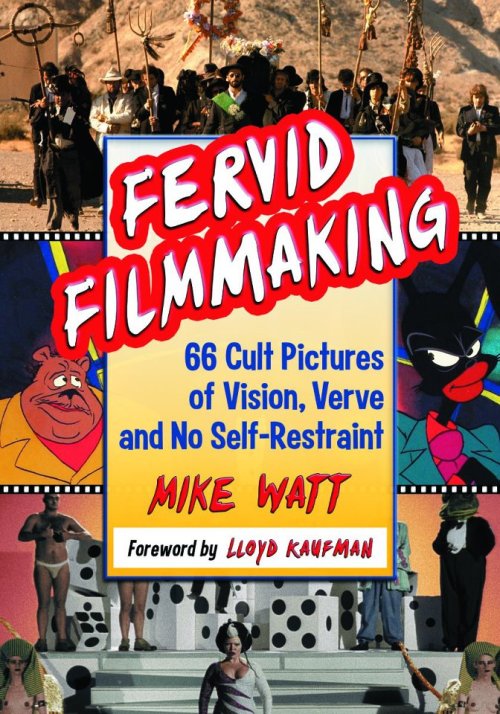
Apologies to my thousands of loyal readers. I had to take some time out to write this upcoming book!


You can pre-order it from Amazon here:

http://www.amazon.com/Fervid-Filmmaking-Pictures-Vision-Self-Restraint/dp/0786470666/ref=sr_1_1?ie=UTF8&qid=1349213718&sr=8-1&keywords=Fervid+Filmmaking

And then Like us on Facebook:
https://www.facebook.com/FervidFilmmakingBookMikeWatt

And more great and wonderful pieces coming very soon!

Wednesday, October 19, 2011

DRONES (2010)


Dilbert, The Drew Carey Show, The Office and Office Space have worked hard over the years to shatter the illusions built up by pro-Capitalism extravaganzas like How to Succeed in Business without Really Trying and Cash McCall. Modern entertainment has proven that corporate-culture office work can be more monotonous and soul-crushing than the first few weeks of military boot camp, certain to leave you a dry and empty husk alone in your cubicle. “Can be”, obviously; much different than “is”. Drones is the anti-“is” in this situation.
The cubicle civilization depicted in Drones is comprised of more or less comfortable workers. Unchallenged though they may be in most aspects of their lives, in and out of the office, the employees of Omnilink are not merely enduring their work-day. They work reasonably-hard doing reasonable tasks and at the end of the day, they go home. Even the artificial crises that pop up—the decreased lead time, the looming deadline—do little to jolt them from their routines. A key element in their daily existence is gossip, and that fills the space between forms and databases. Who is sleeping with who—the essential and possibly only ingredient. If Ian is such a creep, why does Miryam keep taking him back? When will Brian ever ask out Amy? These are the distractions from the database that corporate switched unwisely from its chronological to alphabetical structure. Discussions take place right out in the open because, well, the water cooler doesn’t work.

Encouraging the romantic pairing of Brian (Johnathan M. Woodward of Buffy and Firefly fame) and Amy (cult goddess Angela Bettis) is the centerpiece of Drones, setting the movie’s low-key catastrophes into motion. Office romances, you see, are discouraged by management for a reason. Breakups can lead to hostile working conditions or worse: galactic destruction. At best, it’s a distraction, so everyone would be better off keeping things professional. Unless you want a hostile race of aliens marking the human race for extinction and blowing up the whole planet? You don’t want that, would you? Bad for business.
Directed by Buffy co-stars Amber Benson and Adam Busch, Drones is a dry, droll comedy that has managed to fly under the radar for most of the film-going public. Well-received at Slamdance in 2010, theatrical exposure eluded it because of its very underemphasized nature. Critics dove into their thesaurus of clichés and hauled out that old indie standby, “quirky”, and slapped that appellation over every review. The problem is that Drones is not “quirky”. “Quirky” was coined for movies like Nick and Norah’s Infinite Playlist and 500 Days of Summer and anything starring Zooey Deschanel or Parker Posey (the ‘90s version of Zooey). Drones on the other hand is quite the opposite of “quirky” as it’s the most perfectly-deadpan movie to come along in such a long while.

The strong script by Ben Acker and Ben Blacker (yes, I know; shut up) posits the time-tested hypothesis that aliens walk among us and in Men in Black fashion, they’re prepping reports, Xeroxing documents and shuffling data along with the rest of us. Opening with a Powerpoint presentation that will evoke dread in anyone who has ever endured the real thing, Drones’ company Omnilink is compared to a hive, with each member playing its part for the betterment of the colony. “A bee uses its tongue to extract pollan from a flower. We at Omnilink do the same thing. We use our tongues daily, but over the phone.”

The company’s interpersonal strategy: “The buzz of a job well-done is 1) keeping your cool; 2) reaching out; 3) and interacting with others.” Co-operation is vital and everyone should do their part by visiting neighbor’s cubicles, chatting—“Say, Bob, wasn’t that a great Powerpoint presentation Peter gave this morning?” Human relationships invigorate the hive.

Which is why everyone from supply-closet king Clark (Samm Levine) to spreadsheet crusader Cooperman are pestering Brian to ask out Amy. Not that he sees any problem with that. They’ve flirted in the past, but there are doubts. “She uses capital letters in her I.M.’s,” explains Brian. “I’m more of a lowercase kind of guy.”

“Tut,” tuts Cooperman. “Relish your differences; they're as important as your sames.”
Despite the shock of catching Clark “communicating” in the supply closet and revealing that he’s an alien, Brian retrieves a box of staples and delivers them to Amy. Then pops the question. Which envokes an extremely logical response. “You’ve asked me out in return for bringing me staples. It seems…disproportionate.” But they give it a shot, meet for drinks after work and over the weekend agree that they’re “dating”. Brian hardly gives Clark’s revelation a second thought.

By Monday, Amy is so excited about their new status as a couple that she drops her own bomb on Brian: She, too, is an alien, a race called Soyka, and the copier isn’t her “pet alien robot” but a communication device through which she talks to a co-worker (Jafe) on her own planet (Elg). But this, on top of Clark’s news and the sudden pressure of dating, makes Brian freak out. Unlike Clark’s people, who merely want to enslave the human race—

Clark: Nothing will really change except that I’ll be your boss.
Brian: Can I get a raise?
Clark: Sure!
Brian: Then I’m good.

—Amy’s people want to destroy the planet for fuel. But that plan is on hold “for now”. Brian’s reaction, though, drives a wedge between him and Amy and by lunch they’re no longer dating. The next day, he preps a Powerpoint presentation in which he uses a bar graph to declare that “Amy Is A Jerk”. Still getting used to her new human emotions, Amy doesn’t take well to this sort of thing, particularly as it had nothing to do with the new Planicka account and just serves to extend the meeting. So she contacts her people and tells them that it’s time to move up the deadline. The armada, she is told, will be there sometime after lunch.
Drones pulls this oddball story together with the conceit that, like any other office, this imminent disaster is met with the same urgency as any other client demand. Not only does everyone accept Clark’s and Amy’s extraterrestrial identities in stride but they pull together to help figure out the problem before the planet is destroyed or they have to work overtime. And with this approach, Benson, Busch, Acker and Blacker manage the ultimate triumph of zero cynicism.

Unlike so much of our entertainment, particularly in the realm of “indie” or “quirky”, the Omnilink drones are not the oppressed creatures from Office Space, comprised only of tension and teeth. Drones isn’t about revenge on corporate America but instead tackles the old fashioned notion of doing your job and going home. As ironic a term that “post-ironic” has become, that’s precisely what Drones is about. There’s no winking at the audience, no elbow-nudging or cooler-than-thou posturing. It asks, quite literally, what would you do if you found out a co-worker you liked and thought you knew was going to destroy the planet where you keep all your stuff? Would you go hysterical and attack her with a paper cutter? Or would you just try to talk her out? Because neither is going to make 5pm come any sooner and one seems like it would take more effort than the other. What is the corporate cubicle-jockey’s path of least resistence? And could it be done through interoffice email?

So many things could have scuttled Drones. In the hands of showier directors with something to prove, this alien-invasion-cum-coffee-break could have gone over-the-top, bug-eyes, hysterical mugging, punchlines with the extra punch. But Benson and Busch handle the material with knowing restraint. Even when Brian is at his most hysterical, Woodward’s performance barely raises beyond pitched incredulity. The movie they made is not about madcap artificiality and because of their mature approach Drones is delivered with likable characters and funny material. Nothing is ruined in the name of appeasing the Hollywood over-the-top machine. Which, of course, is why it was deemed an impossible sell.

As of this writing Drones is only available through Amazon’s on demand streaming service or through extended cable (I happened to catch it during a free weekend of Showtime). Reviews for the film thus far either stuff it into the aforementioned “quirky” category or dismiss it outright as a “nothing new indie thing”, citing the amusing score by Jonathan Dinerstein and Dan Bern (and Busch’s band Common Rotation)—especially the appropriate opening song “Strongly-Worded Memo”—as pretentious “prog-rock. (But again, that’s the too-cool-for-you crowd for you, and forgive me if I’m wrong, but isn’t being a hipster no longer cool? Or being knowingly uncool make you cool?) If you can watch it without falling prey to your own misconceptions of what a “festival movie” is or is not, you might find yourself charmed by Drones’ quiet story about humanity, aliens and spreadsheets.

Hail Soyka.

Wednesday, September 21, 2011

THE SWORD BEARER (2010)


“Dude,” as I was addressed by a handful of people, “did you see that new Russian superhero movie, yet?”

I hadn’t. “What’s it called?”

“Mechano-something. I don’t want to give anything away but it’s awesome! The camera is all over the place and the effects are great.”

This was relayed to me a number of times over a period of about ten days. The description always vague and usually leaving me with less information than I had going in. Finally, one of these good Samaritan dudes (and one dudette) included an IMDb link to a movie called The Sword Bearer, aka, in Russia, Mechenosets. Based on writer Yevgeni Danilenko's book, directed in 2006 by Filipp Yankovsky, The Sword Bearer turned out to be something different from what was described. I suspect that these well-intentioned friends were trying to steer me towards the flying-car movie Black Lightning, produced by Timur Bekmambetov, or maybe even Bekmambetov’s Daywatch, because what I got with The Sword Bearer was not a slam-bang actioner, but a very quiet and occassionally disturbing story about a young man who has been ostracized by society for a unique flaw in his genetic make-up.

Unfolding slowly and deliberately, we are gradually introduced to Sasha (a remarkable Artyom Tkachenko), a withdrawn little boy who grows up to be an isolated teenager, shunned by many who know him because of his temper and the violence that results from it. When Sasha feels threatened, a gleaming, indestructable metal blade extends from his wrist. With it, he can cleave stone and wood as easily as flesh and bone, and he doesn’t seem to have the ability to control it, or even set it on “mild injury” much less “stun”. However, he doesn’t pop the blade like Wolverine; the sword bursts painfully through his skin, sometimes skewering the palm of his hand, leaving behind a bloody appendage he does his best to hide with bandages.

Returning to his childhood neighborhood after an unexplained absence, the adult Sasha happens across a girl he knew from school. Her mobster’s son boyfriend and his droogs arrive and beat the young man down in the street, then drive off in their flashy Yay-Capitialism sports car. Tracking them back to her home, Sasha uses a rusty pipe to destroy the car with the bullies inside, killing or severely injuring each one. Shocked by his violence, the girl withdraws and Sasha runs. The next morning, the boyfriend’s connected mother puts a price on Sasha’s head.

In a new city, he meets a woman about his age, Katya (Chulpan Khamatova). They bicker in a stairway then fall into each others’ arms, anger fueling passion. Then her lover arrives home. Instead of offering any explanation, Katya orders the man out of the house. When he attempts to shoot her, Sasha breaks a chair over his head and they leave him tied up. Once freed and out for revenge, he attempts to rape her in the back seat of her car. Sasha’s rescue of her is brutal and horrifying, even to himself. Slamming the would-be rapist overhand into the car’s windshield, Sasha straddles him. Without his bidding, the blade extends and leaves the man bloody and dead, half in and out of the car. Shocked and shamed, Sasha runs and the girl comes up behind him, watching him press the blade tip into the pavement to force it back into his body. 

The brutality and revelation is too much for her and she collapses. Sasha takes her home and she wakes up terrified of him. He hands her the phone, tells her to call the police, but she can’t.

It’s at this very point that you realize that this will not, cannot end well for either of them. This is a movie borne of a tragedy with all the classic tropes—misunderstood hero, doomed lovers, society mistaking iconoclasts for the mentally ill, the disease of revenge—all distilled into an odd little metaphor that is rarely even visual. The blade represents Sasha’s isolation, his barely-controlable rage; the bloody path left behind him are predominantly accidents—just as the first time, as a child, when he defended his mother by murdering his stepfather; when he protected a schoolmate from an escaped prisoner. First we see the wooden sword in young Sasha’s hand, then the bloody corpse on the floor.

Restrained and disciplined, Yankovsky never allows The Sword Bearer to dab even a toe into X-Men territory. Preferring to show the aftermath of Sasha’s emotions, at no point does the director attempt to ape western testosterone set pieces. We never see, for example, Sasha racing down a hall, blade extended, mowing down assailants. (The best we gorehounds get is a shot at the rear of a police van, a cascade of blood spilling through open doors and around Sasha’s boots, once belonging inside the half-dozen men escorting him to prison.) He’s not a superhero; the blade isn’t a curse. It’s just a part of him he doesn’t understand. He can’t even extend it at will, to prove his story to a policeman who is eager to hear any rational explanation. When it does emerge, he can cross-cut forests, cleave tractor trailers in half. Even then, Yankovsky keeps the blade obscured by action, more a force than a weapon. When we watch Sasha slice off the tail of a helicopter, we realize that the blade’s length is as infinite as his rage and grief, and many more times powerful.

Going into the film blind, The Sword Bearer became for me a very pleasant surprise, but one that demanded my attention (and not just because all the subtitles were about a full-second off, making following the subdued story even more difficult). Not everything is explained but then not every detail is necessary. All we have to no that a very special man is in love with a very special woman, that they’re both damaged in their own way, and that the world is a cold, hard place that has no interest in understanding them. It’s a very simple story wrapped up in an atypical narrative.

Depending on your own tolerance for deliberately-paced movies (what some may call “boring” and not unjustified), you’ll either find The Sword Bearer remarkable or intolerable. And for this reason, in addition to the subtitles and the presence of actors who may be acclaimed in Russia but are virtually unknown here (until they’re hired to play thuggish villains for the next Jason Statham movie), Mechenosets did not receive a wide release in the U.S. It played festivals in the big cities but was not released on domestic DVD. But even abroad, the pacing and open-ended questions, primarily concerning Sasha’s origins and any explanation of the blade, have left many viewers frustrated.

It’s at this point in the review when I suppose I should ask, pretentiously, if subtlety and allegory have been completely bred out of our DNA, regardless of location. Because I found meaning and satisfaction instead of explanation doesn’t raise me above or place me below another viewer. The Sword Bearer is a story about a scream told in a whisper. Whether you dig it or not will depend on how loudly you want to hear a story like this and when you’re willing to hear it. 


Tuesday, September 20, 2011

D.C. CAB (1983)


Once upon a time, the phrase “Directed by Joel Schumacher” was not met with the revulsion and disgust that it is today. Rather, the director was considered with thoughtful indifference. It wasn’t too long ago that filmgoers left a Schumacher film thinking “gee, that could have been a lot worse”, instead of cursing the god that created him. Flamboyant in life but not in his art, Schumacher can be best-thought of as a competent director, serviceable perhaps, before he started putting nipples on everything. In the mid-‘80s, the young writer and director had perhaps already risen to the height of his adequacy with back-to-back successes appealing to the shallow youth in us all, St. Elmo’s Fire (1986) and The Lost Boys (1987). Today, like most of his pre-Batman efforts, these are great soundtracks in search of better movies, but they still managed to rake in enough money at the box office to garner him subsequent work. After writing two flops—Car Wash and The Wiz—Schumacher made his directorial debut with the Lily Tomlin hit, The Incredible Shrinking Woman. And that led him to perhaps his most infamous achievement, D.C. Cab.

Like Car Wash and The Wiz (I guess), D.C. Cab is another street-wise, working class adventure set against a flashy backdrop of poverty. The set up is fresh from dozens of previously made movies: a group of multiculture misfits working in the same environment learn to unite thanks to the intervention of a brand new white boy. In this case, obviously, the titular company is a bottom-feeding hack outfit headed by Barney Miller’s own Max Gail, the fleet driven by the likes of Mr. T, Paul Rodriguez, Bill Maher, Marsha Warfield, Gary Busey, Charlie Barnett and the Barbarian Brothers. The new white boy with the big ideas is Adam “No Relation” Baldwin as Gail’s nephew. The movie has less of a plot than it does a board game goal: get the misfits from start to finish, band together and keep the company from folding into bankruptcy. Accomplish this by first focusing on the disparity of personalities, loudening the profanity and sex jokes (and racist and homophobic jokes, bless their hearts), and then manufacturing some larger-than-life crisis that will point out how these aforementioned differences can be cast aside when push comes to shove and lives are at stake.

You’ve seen this movie. Maybe not this movie, but surely Porky’s, Animal House, Quicksilver, Police Academy. There’s nothing wrong with this formula. It works. It always works. It always will work, no matter how much Paul Rodriguez you throw in there. It even works in spite of the movie’s structure, which seems to operate under the philosophy, “It doesn’t matter if one scene has anything to do with the next so long as we have a cool song playing, somebody swears, and, oh, what the hell, put a lap-dissolve at the end.”

Take, for example, the pre-credits sequence in which the shrill and soon-to-be-hated-at-least-by-me Barnett is chased in his cab by a platoon of other cabs, their drivers wearing comically-sinister rubber masks. After blocking in his ride, they corner him in a dark and locked parking garage. Just as you’re sure that the African-American man wearing a ‘fro of curlers is about to meet his doom, laughter ensues, masks are removed revealing vaguely-recognizable actors playing future characters. Cue credits and then never reference this situation again (except in a vague way towards new white boy Baldwin, who is told that all new drivers have to make “the run”). As a hook, it doesn’t work. As a character-building sequence, it doesn’t work. But as an ease-in for the target demographic, the pot-heads, it works like a dream. So do the multiple brawls, the dirty jokes and every scene where Gary Busey seems to be taunting an off-camera orderly armed with a tranquilizer gun.

In Sweet Liberty (1986), Alan Alda’s character posits that a movie has to contain three elements to be successful with modern audiences: 1.) Disrespect of authority; 2.) Destruction of property; 3.) People taking their clothes off. Check, check, and check. So while D.C. Cab wasn’t the box office smash the studio had hoped for—even with focusing all advertising on Mr. T, who’d become an overnight sensation following the previous year’s smash hit Rocky III—it led a long productive life in video stores and on cable television. This cemented the careers of Schumacher and T, at least and allowed Rodriguez to escape unscathed for another decade. Baldwin would move forward into much more psychopathic roles, culminating in the most beloved character of all time, Firefly’s Jayne Cobb. Eventually, Maher would hang up whatever persona he’d been trying to cultivate as an actor and would evolve into a political satirist. Marsha Warfield found a home on Night Court. And the “special guest star” Irene Cara would survive her inconsequential cameo appearance to become the singing sensation she had been three years prior.

What makes D.C. Cab so fascinating is the sheer number of famous faces present in the film. While working on the index for a collection of reviews, I discovered that 1-out-of-every-6 people I cited either had the movie on their resume or a six-degrees tie to it somehow. Bring the movie up to fellow ‘80s children and you’ll get fond memories from many provided they hadn’t actually seen it since grade school. It’s slipshod editing and seemingly-random direction definitely qualifies it for “guilty pleasure” status. There are plenty of good lines, though Busey gets most of them.

Dell: Heck nobody goes in the army any more, except blacks. Someday one nigger's gonna wakeup and say, "We got the guns and the mustard gas and the tanks, hey were runnin the army!" And they're gonna take over the whole damn country and we'll be in with them already - we'll be Token Whites. Think about it.

Dell: Bruce Lee ain't dead you know. They got him frozen in carbonite down under Chatsworth. They're gonna melt him down as soon as the economy gets better.

However, it’s Barnett, the most grating character, who gets the best tag of any movie of the era, because of a deadpan delivery that had to have been jettisoned early in favor of his shrill “jive-turkey” schtick. It begins when none other than Timothy Agoglia Carey sits down in the back of Barnett’s cab:

Tyrone: Where to?
Angel of Death: I am the Angel of Death. Take me to hell.
Tyrone: Got any luggage?

In short, it’s a movie that doesn’t ask anything of its audience. By the early ‘80s, this sort of controlled chaos was so familiar, the paint-by-numbers plot was unnecessary. The Underdogs become the Good Guys in the end. That’s the slug line that undoubtedly sold the script, that’s sold thousands upon thousands of scripts since the beginning of Hollywood. Nothing else matters except for the number of cars involved in the crash, the big set piece and how insane the various characters are allowed to be. Schumacher could have delivered a movie cobbled out of left-over frames from the countless comedies that came before it and it still would have made money. It’s the mantra of Meatballs: “It Just Doesn’t Matter”. A paycheck for the fantasy football cast; something to flash across the eyes in an air conditioned theater during a hot summer day. Subversive only to those who still believe that “they shouldn’t be allowed to say stuff like that!”

This low-expectation continues to attract the audiences today. There’s no difference between D. C. Cab and Hot Tub Time Machine or The Hangover or Hall Pass save the faces occupying the blank spaces where characters should be. We’re living in a green society; what better recyclable material than Hollywood comedy?

Friday, September 2, 2011

THE FRONT PAGE (1974)


With the print industry dying a slow, strangling, agonizing death in the current climate of iEverythings, it seems not only fitting and nostalgic but grimly ironic to take a look at a story that has both lionized and demonized both the newspaper business and the crack journalists who work for The Fourth Estate. Written in 1928 by former Chicago writers Ben Hecht and Charles MacArthur, The Front Page is as true in its cynicism as it is today, performed on stage almost constantly since its pre-Crash premiere and, without taking into consideration the numerous television versions, has been directly adapted for the big screen no less than four times.

The gist: The Front Page takes place on the day before poor Earl Williams, commie sympathizer or dupe and the alleged murderer of a black policeman, will be led to the gallows. Crammed inside the Press Room of Chicago’s Criminal Courts Building, reporters from most of the city big sheets play poker and make horrifically inappropriate jokes about the various horrors of the world as well as Earl’s big kick-off. Enter Hildebrand “Hildy” Johnson, crack reporter from the Chicago Examiner, there to say goodbye to the gang. He’s off to get married and get a respectable job. More importantly, he’s looking to get out from under the Examiner’s tyrannical editor, Walter Burns, who’d commit murder to get that scoop-worthy headline. Suddenly, shots rip through the windows—Earl Williams has escaped! When the other hacks race out to the scene, Hildy stays behind to bask in the quiet. Through the window crashes Earl Williams—a meek little guy who’s been railroaded by the Chief of Police and the Mayor (a corrupt Chicago mayor? Such fancy!) for an election-week stunt. Hildy is faced with a dilemma. He can either leave with his fiancée, Peggy, as planned, and escape Burns and the soul-killing news biz forever, or he can stay behind, shelter Williams and write a piece that will exonerate him once and for all. But to do that, he’d need the help of the hideous con man, Burns.

Keppler: “This is my first hanging.”

Hildy: “Don’t worry kid, this is Williams’ first hanging too.”

The play’s first trip to the movies came about in 1931, starring Adolphe Menjou and Pat O’Brien. (Don’t “who?” me! Menjou was the original “Billy Flynn” in Roxie Hart, basis for Chicago. O’Brien was friggin’ Father Connolly in Angels with Dirty Faces. “Who” indeed.) It played pretty close to the original script with very little action occurring beyond the press room.

Murphy: “Update on the Williams hanging: Sheriff Hartman's just put 200 more relatives on the payroll to protect the city against the Red Army, which is leaving Moscow in a couple of minutes. Bet a dime.”

Arguably the most famous and beloved of the adaptations is Howard Hawks’ near-perfect His Girl Friday with Cary Grant and Rosalind Russell. (Spin the dial, so to speak, to one of the cable movie sections, guaranteed it’s playing on one of them this very minute.) Working from Charles Lederer’s script, Hawks flips Hildy’s gender and makes her the ex-wife of Walter Burns, which bringsWalter into the story earlier and adds not only the much-needed team-up but a bit of Hayes-approved sexual tension. It also stars the fastest-spoken dialogue in movie history.

Thus far, the last remake of The Front Page is an untidy and unpleasant little mess from 1988, starring Burt Reynolds and Kathleen Turner called Switching Channels, the setting a television news stage, rather than the press room. Mean-spirited and misanthropic rather than cynical, this movie reportedly suffered from the two leads’ mutual abject hatred of each other, which is reflected in the film’s energy. If it weren’t for Joan Cusak as a loony assistant, the movie would be a complete wash.

Between the sublime and the hideous is adaptation #3 which premiered in 1974. Starring Jack Lemmon and Walter Matthau. Directed by Billy Wilder. With a script by Wilder and his astute partner I.A.L. Diamond. Gold, right? Sheer gold. Run with it, Duffy and let it hit the streets!

Well, gold plated, at least. Still a good value with today’s market.

Hildy: [to Sherriff Hartman] “You what I think, Hartman? I think you let Earl Williams out yourself so he could vote for you next Tuesday.”

By the ‘70s, Wilder’s career was faltering under the weight of his own greatness. Bitter at the Hollywood industry that he more or less owned in the ‘40s and ‘50s, Billy made some odd choices. For one thing, the snappy Hechtian/MacArthurian dialogue was “sweetened” by Wilder and Diamond, mostly to great effect, but so married were they to their own words that they forbade the rapid-fire overlapping delivery that made His Girl Friday such a hit. Even Lemmon and Matthau wanted to keep the furious pace, but Billy the writer wouldn’t hear of it, likely in direct opposition of Billy the Director.

Walter Burns: “Jeez, Hildy. why didn't you tell me? Kid, I woulda thrown you a little farewell party... “

Hildy: “Oh, no, no, no! I know your farewell parties! When Ben Hecht was leaving for Hollywood, you slipped a micky in his gin fizz. It took four of us to get on the California Limited.”

Walter Burns: “Ben Hecht! Used to be one of the greatest newspaper men I ever knew. Look at him now, sitting under palm trees writing dialogue for Rin Tin Tin.”


Secondly, given the freedom to not only use the spicy language of pre-code Front Page but also the saltier speech of the ‘70s, the use of profanity is almost constant. Not a big deal today, when Baby’s Day Out sounds like Scarface (hyperbole intended), but for a movie set in 1929, the language sounds incongruous, even if it is actually more accurate. All the “goddamns” and “bullshits” muck up the rhythm of the patter moreso than the line-then-next-line delivery.

Hildy: “I wouldn’t cover the Last Supper for you if you had it in the Pump Room of the Palmer House!”

Thirdly, when you go to see a Lemmon/Matthau movie, you expect the two of them to be in the room together for more than just the third act. By hewing to the original Hecht and MacArthur structure, Walter Burns (Matthau) is kept at the Examiner for far too long. Not that Lemmon (as Hildy) isn’t entertaining by himself (or surrounded by Charles Durning, Herb Edleman, a glib Harold Gould, a giddy Austin Pendelton), but the give-and-take that made The Odd Couple and The Fortune Cookie so wonderful and electric is held off to the point where the movie seems to slog along until the last forty minutes. Once Walter Burns finally shows up, things pick up steam again, but by then the meanness and the hysteria and the overacting (Carol Burnett and Vincent Gardenia) has worn a path through the audience.

Like Switching Channels later, Wilder’s The Front Page adds too many barbs to the wire. The cynicism doesn’t seem borne out of world-weariness on the parts of the newspapermen and the corrupt governing system, but out of some sort of utter hatred for the world. Some may find nihilism and fatalism funny, but here it crams the other elements against the wall. Wilder made his career revealing the skuzzy side of the world to the audience with black-humor. Double Indemnity and Sunset Boulevard spring immediately to mind when you think of cultural skewering and reversal of expectation. But towards the end of his career, Billy had started to see the world through smoked glass. That antagonism spilled into his work and literally weighed it down (just as it would in Fedora and Buddy Buddy).

For those like myself who believe that bad Billy Wilder is better than no Billy Wilder at all, The Front Page is hardly an appalling waste of time, but far from honorable satire. Maybe if Wilder had updated it to the decade in which it were made, the culture shock may have been lessened, the jokes seeming a little more biting with current issues addressed. But the idea of a “Red”, who’s reputation was made for sticking “Release Sacco and Vanzetti” into fortune cookies would have been too trite for 1929. In 1974, it was almost insulting and doesn’t adequately translate. (Although the idea that Williams got beaten up by a crowd of pimps for trying to get hookers to unionize is definitely funny.)

Dr. Max J. Eggelhofer: “Tell me, Mr. Williams, were you unhappy as a child?”

Earl Williams: “Not really. I had a perfectly normal childhood.”

Dr. Max J. Eggelhofer: “I see. You wanted to kill your father and sleep with you mother.”

Earl Williams: [to Sheriff Hartman] “If he's gonna talk dirty ...”

Even Billy himself would admit that The Front Page was, despite its moderate box office success, a mild misfire. “I'm against remakes in general,” he said, (Nobody's Perfect: Billy Wilder, A Personal Biography, Charlotte Chandler, 2002.) “Because if a picture is good, you shouldn't remake it, and if it's lousy, why remake it? . . . It was not one of my pictures I was particularly proud of.”

It wasn’t the remake status that held The Front Page back. The themes are universal even today in the era of information saturation: political malfeasance and nonfeasance; reporters out for blood to smear across their headlines (or click-through links) and the weariness that comes from a slow loss of soul; equally bloodthirsty readers ready to form a pitchfork-bearing Simpsons mob at the slightest change of wind, seeing injustice in jaywalking and racism in Neopolitan ice cream.

Think what Hecht and MacArthur would make of today’s “journalism”? Live blogging from anywhere, just so you can say “First”. (“First” being the new scoop.) Letters to the editor morphed into virulant posts left on Yahoo! News, revealing the basest of all human traits as misanthropy spews across the screen. Aside from the technology, nothing has changed since 1928, certainly not human behavior when one thinks nobody is looking. 

Friday, August 26, 2011

BUDDY BUDDY (1981)


In 1966, Billy Wilder wrote and directed what was considered to be his last inarguably great movie, The Fortune Cookie. Notable for many things, particularly the first on-screen pairing of Jack Lemmon and Walter Matthau, a Golden Globe nod and an Academy Award for Best Supporting Actor for Matthau, nominations for the screenplay by Wilder and his long-time collaborator I.A.L. Diamond, as well as for Cinematography and Art Direction. It was a box office hit and solidified that Wilder was an unmitigated Hollywood maestro.

Four years later, after a series of stalled productions, Wilder wrote, produced and directed The Private Life of Sherlock Holmes, meant to be an “event” picture it was butchered by United Artists and opened to critical applause but little financial success. Following that came a series of failures: Avanti! (1972), The Front Page (1974—surprisingly given the reteaming of Matthau and Lemmon) and Fedora, a movie whose tumultuous production almost forced Wilder into retirement.

After another three years, give or take, Wilder began to complain publically that he was being discriminated against in Hollywood, because of his age, because of his last few “failures”. Movie culture had changed underneath him. What used to be daring—the smoldering infidelity of Double Indemnity, promiscuity of Some Like It Hot and The Apartment—was now tame in the time of Taxi Driver, The Godfather, Jaws, Carnal Knowledge, The Graduate.

Then MGM acquired a quiet French black comedy from 1973, L'Emmerdeur, starring Lino Ventura and Belgian pop singer Jacques Brel. Screenwriter Francis Veber (Les Fugitifs, Le Chevre) adapted his play Le contrat specifically for Edouard Molinaro (La Cage aux Folles). A hitman named Milan who checks into a hotel to take out his next target, a witness for an upcoming trial. In the room next door is François Pignon, who keeps trying to kill himself now that his wife left has him. The resulting story is a comedy of misadventure as Milan is forced to deal with Pignon in one way or another to keep the sad sack from attracting unwanted attention.

In France, L’Emmerdeur was extremely successful (Veber himself would direct a remake in 2008), to the point that the Yiddish word “schlemiel” is translated as “François Pignon”. In the United States, L’Emmerdeur was released as A Pain in the A__, finding a decent-sized audiences in the Art Houses and on the emerging world of cable television (especially a young upstart channel called Home Box Office). MGM figured they had nothing to lose by remaking it for the casual, non-subtitle-reading American viewer, and to that end, they brought it to Billy Wilder.

Wilder, desperate to get back to work after a three-year black-out, leapt perhaps too quickly at the opportunity. He and Diamond hammered out the finished script in a matter of weeks and embarked on a whirlwind production. Later in life, Wilder would say, “If I were to meet all of my movies in a room, Buddy Buddy is the one I wouldn’t want to face.”

Buddy Buddy begins with a pair of murders—a mailman leaves a bomb in the box of one man and a milkman poisons the cowjuice of another. Both are the blank-faced Trabucco, who is working his way through the witnesses of a huge upcoming land fraud trial. Last on his list is mobster Rudy “Disco” Gambola, who has turned state’s evidence for the prosecution. “Hello Mr. Green?” he says, calling his bosses. “Oh, Mr. White... let me speak to Mr. Brown...” (Sound an eentcy bit familiar?)

Trabucco checks into a hotel room, begins to assemble his high-powered rifle when a loud noise comes from the room next door. Through the connecting passage, he finds Victor Clooney lying unconscious in his bathtub, around his neck a noose made from the curtain sash. Since Victor tried to hang himself from the shower pipe, water pours into the room and he’s now in more danger of drowning than strangling.

From there, Clooney continues to inadvertently make Trabucco’s life miserable. Mistaking the hitman’s insistence that Eddie the Bellboy not involve the police—“Can’t you see this man needs compassion? The warmth of human understanding?”—for genuine concern and the extended hand of friendship, Clooney bedevils the poor hitman to no end. Forced to assemble and disassemble his rifle more times than is necessary, Trabucco tries to first get incapacitate Clooney by tying him to a chair (“You’re making it very difficult for me to like you!”), then rid himself of Clooney entirely—thwarted by the sudden appearance of cops escorting a woman in labor to the hospital—then pawn him off at the same sex clinic where Clooney’s wife left him for the head therapist.

Each time, Clooney returns to wreak more havoc on Trabucco’s life and plans. This was his last job, of course; the one he could retire on. The one that could get him killed if he botched it. “This was gonna be it. Enough money to retire on because in this kind of work you don't qualify for social security.” An easy gig if he could just get this schlemiel of a François Pignon off his damned back! Along the way he grows to, well if not like Clooney per ce, at least begrudgingly tolerate him. This change in relationship lead to the movie’s best moments: those involving Matthau, Lemmon and their trademark back-and-forths.

Clooney: Have you ever been married, Mr. Trabucco?

Trabucco: Once but I got rid of her. Now I just lease. I once knew a guy, he had two heart-attacks. So they put in him a pace-maker. So his wife divorced him. She said it was interfering with the tv-reception.

Clooney: Are you from L.A.?

Trabucco: Not necessarily.

Even with the winning team of Matthau and Lemmon, and a bizarre supporting cast of Paula Prentiss, Klaus Kinski, future MacGyver co-star Dana Elcar and an early appearance from Ed Begley, Jr., Buddy Buddy never really gets up a full head of steam. Perhaps hewing a little too closely to the understated pacing of L’Emmerdeur, Wilder’s and Diamond’s manages a lot of chuckles but never the belly-laugh you’d expect from the team. The movie transitions from one scene to the other in fits and starts and only really comes into its own when Clooney is finally tired of the humiliation and becomes his own man, to defend Trabucco.

Trabucco: Do me a favor.

Clooney: Yes ?

Trabucco: Fuck off.

Cue screeching brakes and an entire audience suffering whiplash from severe brain disconnect. In the late ‘70s, such language was far from uncommon. The double-entendre had already been demoted to single and before too long, even Julie Andrews would pop her top (in Blake Edwards’ S.O.B.). But there was an oddness to hearing the word “fuck” come out of Walter Matthau. There’s also something unsettling watching Lemmon discuss orgasms and penis size with Prentiss and Kinski (heck, Kinski playing a man any woman would leave her husband for is unnerving enough). With one word, Wilder crashed into New Hollywood.

It wasn’t a new word for him. In fact, in his private life, he was known to enjoy using it. Probably even enacting it. I don’t like to think about that, though. Matthau was notoriously grumpy, acerbic, misanthropic. But he didn’t work blue—especially not with Lemmon. MGM saw a way to bring a tired workhorse in from the pasture for another go, thinking it would be a cheap way of getting a moderate hit on the screen.  In an attempt to “spice things up” for modern audiences, Wilder and Diamond failed to realize that along with new viewers, older Wilder fans still came to the movies to see a Wilder Movie. That had been his point all along. He wasn’t too old and he was still big, Norma Desmond big and you don’t get bigger than that.

Those unfamiliar or dismissive of Wilder may think me prudish right now but the trouble was, Wilder didn’t work blue because he didn’t have to. Wilder was an intellectual and thrived by confounding the censors. He hid the dirty stuff between the lines of dialogue, between fade downs and fade ups. It was akin to Groucho Marx exposing himself to an audience—it wasn’t beneath him; there was no need. Wilder and Diamond’s script worked too hard for the new viewers. They gave them what they wanted and you should never do that. Wilder always gave the audience something new, something they hadn’t known they’d wanted. That was the key to Billy’s brilliance. Desperation for work forced him to sell out in every sense of the word. He didn’t make the movie he wanted to see, but what he wanted to sell.

Buddy Buddy failed at the box office but did reasonably well on cable. The critics jumped up and down on it for many reasons, language not being among them. The disinterested pace, the uncomfortable characters. Matthau was criticized for not being Clint Eastwood, whom many felt would have been a better choice for Trabucco, a sentiment that was shared by both Wilder and Matthau. And like Trabucco, many found Clooney very difficult to like. For years, Klaus Kinski denied he was even in it! (Think about that—you’re in the room with Kinski, the movie is on TV and he’s just shaking his head. “But…but Klaus—that’s you! You’re right there! Look, see you on screen?”) At the time, it seemed like a sour note on which to end. For Wilder, it would be the last feature he’d direct.

With thirty years of hindsight, Buddy Buddy can be viewed as a slight, flawed, but still reasonably solid offering from Billy Wilder. It wasn’t The Fortune Cookie, but the nice thing was Billy never sold you the same thing twice. In fact, it’s fun to watch it back-to-back with L’Emmerdeur for both the similarities and the differences. They’re both low energy comedies with light chuckles, no guffaws. They’re even both sporadically available on DVD (although Buddy Buddy is currently only available on a Spanish import).

While it’s not the case, it could be easy to leave a discussion of Buddy Buddy on one exchange of dialogue. It’s tempting, but it’s only partially true, just like the sentiment behind it:

Clooney: Here I am, almost didn't make it.

Trabucco: Almost doesn't count.