Thursday, November 15, 2012

TWINS OF EVIL (1971)

(Image from Wrong Side of the Art)
If we’re going to maintain our open and honest relationship here, I have to confess that I’m more a Hammer afficianado than an outright fan. Even during their heyday in the mid- to late-‘60s, their budgets were minimal and it showed all over the screen. My favorite of their dubious trademarks included towns located on some strange time-split where it was often and simultaneously daylight on one side and misty night on the other. But where they lacked in money their movies made up for in atmosphere and a sense of otherworldliness. More importantly, they employed a pair of actors who lent gravitas to the proceedings: Peter Cushing and / or Christopher Lee. As long as one or the other appeared in the film, you were guaranteed some level of enjoyment.
For me, Hammer movies seemed to follow a standard beat sheet: Intriguing opening, usually bloody; then came the long middle part where carbon-copy young lovers, usually star-crossed, are introduced, their family feuds established, and perhaps hidden amongst all of this you’ll get a fun set-piece involving fangs or monsters but always cleavage. Finally, an exciting climax and a bloody ending. Since Hammer was competing with larger companies they continually pushed their “blood ‘n boobs” formula as hard as they could against the membrane of censorship also known as the British Board of Film Classification. Long before the board caved to pressure from self-appointed Minister of Decency, Mary Whitehouse, the BBFC during the Hammer years were actually pretty progressive, as far as censoring outfits go. This is largely due to the presence of Secretary of the Board, John Trevelyan, who saw his role in and of the board as men who are “paid to have dirty minds”. From 1958–1971, Trevelyan attempted to work with filmmakers and explain what cuts had to be made prior to a film’s release.
Of course, that’s his point of view. Some filmmakers, naturally, felt that he was the ultimate enemy. Roy Ward Baker, who directed The Vampire Lovers and Scars of Dracula for Hammer, notoriously called Trevelyan a “sinister mean hypocrite”, who played favorites with those he felt were in the “art house crowd” as opposed to commercial film directors. Acording to Baker and echoed by others, Trevelyan “kissed ass” with the bigger names in British Cinema. This relationship was sorely tested by Ken Russell and his still-controversial masterpiece, The Devils. While the two men warred over a sequence dubbed “the Rape of Christ” (a ten-minute scene that has only recently been restored to prints of the movie), John Hough took advantage of the distraction as he readied Twins of Evil for screens.
Twins of Evil is the third film of the so-called “Karnstein Trilogy”—the previous being The Vampire Lovers with Ingrid Pitt and its follow up Lust for a Vampire—all based on J. Sheridan LeFanu’s ode to the sapphic vampiric, Carmilla. Adapted by future rabble-rouser and trade unionist, Tudor Gates, the “Karnstein Trilogy” are perceived by some to be the last “great” films of the Hammer era, before their slide into utter poverty, and are notable for daring depictions of lesbianism, a theme that had gotten ten minutes chopped from “art house” film, The Killing of Sister George, in 1968.
As a trilogy, the “Karnstein” storyline doesn’t really work, having no real continuity to speak of, except for the name of the evil family and their matron, Mircalla (aka Carmilla). The first film of the series, The Vampire Lovers, set film-goers all a-twitter with its boundary-leaping scenes of blood and nudity and girl-vampire on girl-vampire action. The next two installments were toned down for British sensibilities.
While tamer than its predecessors, Hough’s Twins of Evil exploits some of this newfound exploitative freedom by casting Playboy’s first twin playmates, Mary and Madeleine Collinson, as the titular characters (no puns, please, we’re British). Maria and Frieda Gellhorn arrive in Karnstein from Venice, two years after their parents died. They show up at their Aunt Katy’s house in green, instead of the customary black-for-the-rest-of-your-lives. This enrages puritanical Uncle Gustav Weill (Cushing). “What kind of plumage is this? Birds of paradise?” But don’t be too hard on Uncle Gustav, he and The Brotherhood have been busy burning witches all night, doing God’s work. And by “witches”, these Bible-weilding psychopaths mean “unmarried women”, “women walking alone on a road”, “old crones”, anyone who has ever thought about having sex—you know, witches. In fact, the title sequence portrays one of these boys-being-boys bonfires after dragging a teenage girl forcibly from her home, lashing her cruxifix-style to a tree and then setting her on fire. And she screams and screams as the “devils” flee from her “purified” body. In the back, Pat Buchannan nods approvingly.
Within seconds of arriving, the more-willful Frieda is ready to skip town as soon as she can find someone appropriately handsome and dangerous. One of Gustav’s primary adversaries is Count Karnstein himself (played by Damian Thomas, best-known as the baboon prince Kassim in Sinbad and the Eye of the Tiger), a decadent lover, vague ruler and admitted Satanist who takes great delight in humiliating Gustav and his puritanical ways. Which, this early in the film, is a point in his favor since thus far Gustav has failed to win the hearts of the minds of the viewer.
But then we are whisked away to Castle Karnstein where the Count is being bored out of his mind during an actual Satanic pageant. Once he angrily dismisses the players, he finishes the sacred “stab the naked girl” ritual himself, evokes Satan but winds up with Mircalla instead. She makes him into a vampire (in a nifty shot in which she stands behind Karnstein but he alone is reflected in the mirror, and he watches himself fade away as he turns fangy).
Before long, Karnstein is out to find something of Gustav’s to corrupt and sets his sights on Frieda. Frieda is loved and admired by schoolmaster Anton (David Warbeck of Fulci’s The Beyond)—literally, he can only see her, the rest is vaseline on the lens—when he really should be attracted to the more-demure Maria because… well, hell, she looks just like Frieda but she isn’t a bitch. Besides, as everyone—everyone—points out, the two sisters simply cannot be told apart. Frieda exploits this by sneaking about at night and making Maria pretend to be her, so that Maria gets beaten twice (it’s implied by not only Gustav but every patriarchal figure they’ve ever encountered). Strangely, Maria can sense when Frieda is hurt, but either Frieda can’t feel Maria or just doesn’t give a damn.
As typical of Hammer, no one heeds the vampire warnings (even though, apparently, there’s already one running around long before the Count is turned during sex with his dead relative), more busty girls are either bitten or are flame-broiled by Gustav, and Frieda tramps around with Karnstein until she, too, is a mistress of the night. Her first task is to bite into the plump breast of Luan Peters (aka singer Karol Keyes) before the camera quickly cuts to anything else lest Trevelan wield his scissors.
If you’ve seen a Hammer film—any of them—you know what’s going to happen. But Hough and Gates pull some nifty turns along the way. When Gustav catches neice Frieda feasting on one of the Brotherhood, he has her locked up so that he can make sure the rest of the family is safe, planning on burning her later. Sorry, purifying her later. But Karnstein manages to switch Maria for Frieda and soon it’s the nice slutty twin that’s heading to the stake and Hough plays this sequence to the hilt of suspense. 
The second twist is far more subtle and involves Gustav’s character, which more than proves Cushing’s a master thespian. After he almost turns the incorrect neice into jerk chicken, Gustav’s faith in his own crusade gets shattered. This is never discussed openly, but you can watch it work on Cushing’s face. Used to the seat of power, when Anton presents Maria with a crucifix and she kisses—rather than sizzling beneath it like Fried did—Gustav is visibly shaken. While he never says it, it’s clear he’s wondering how many other innocent women have been put to death under his pious wrath. We see a glimpse of his regret just as he’s about to put the torch to Maria, refusing to pass it to his second in command—this isn’t some random wench to be roasted for fun and, you know, “God’s will”; this is his neice, who he swore to protect. The realization that he could very well have killed his own flesh and blood in the same manner as he had “purified” so many others chills him.
After this sequence, Gustav still leads the Brotherhood but defers to Anton. “You’re sure a stake to the heart will release [Frieda]? That her pure spirit will be saved?” For the first time in the film, we see all his noxious, prideful bull-puckey summed up in a question. Maybe the others in The Brotherhood were just out for a rolicking witch-burning, but Gustav honestly—honestly—believed he was saving the innocent souls of the wicked. Without the subtlety of Cushing’s performance revealing the man beneath the zealot, Gustav could have remained a villainous figure for the rest of the picture.
While Count Karnstein is really the villain of the piece—with his fangs, his coiffure and cape—but more than anything, he’s just kind of a dick. He spends the climax in a vault, shoving out or dragging in one sister after another and locking the door again, taking few steps to take the upper hand. Gustav, for all his evangelical lunacy, was a man of action and principals. Yes, he shared Karnstein’s arrogance, but he wasn’t out burning witches every night because he was bored.
It’s this last-act transformation that allows Twins of Evil to rise above its formula. It’s not the first time Cushing has helped this elevation; each of his turns as Baron Frankeinstein in the Hammer series shows a different man beneath the madness. But beyond the sex, blood, atmosphere and pretty photography, Twins of Evil gives the viewer something to think about, namely: think long and hard before you’re convinced of your own righteous. 

Friday, November 9, 2012

FEDORA (1978)


Before we begin, I have two caveats: First, I will ruin both the ending and the beginning of this movie. Second, this is less an essay than it is an apology, but more on that later. 


Now then:
Fedora opens with the titular character, a one-time movie star with a literally ageless beauty (played by Swiss actress Marthe Keller), hurls herself in front of a moving train, ending her life and her legacy. (That she does this after having fallen in love with Michael York, playing himself, is revealed later and should come to no great surprise to anyone, really.) Her funeral is an event unto itself and chief among the mourners is her once-upon-a-time lover and soon-to-be-has-been producer, Barry “Dutch” Detweiler (William Holden). Just two weeks before her suicide, Dutch had visited her in the hopes of convincing Fedora to return to the screen as a new Anna Karenina.
Not only does she refuse the role, but she tells him a strange tale that she’s being held captive in a private Villa on an island near Corfu, Greece. Her gaolers included her shady chauffeur Kritos, her shadier and jumpier servant Miss Balfour, her personal physician and possible plastic surgeon, the mysterious (and shady but less-jumpy) Dr. Vando and, last but not least, the extremely old Countess Sobryanski. When Dutch tries to help Fedora escape, Kristos clonks him unconscious, in which state he remains for over a week. By the time he recovers, Fedora has killed herself.
Dutch flashes back to the time when he first met the beautiful and (supposedly) talented Fedora, when they were both young, when he was an up-and-comer and she was an already-there. In the form of Stephen Collins (an almost-acceptable choice for a younger Holden), they begin their brief and torrid affair. As Dutch’s career ramps up, Fedora disappears for a spell, then reappears years later without having aged a day. Her only affectation seems to be for shoulder-length gloves, which she wears everywhere. It’s even in her contract that she be permitted the accessories on film, regardless of the role or the temperature.
Fedora resumes her stardom with nary a hitch. But she starts to get weird after meeting and falling for Michael York. Prior to their first scene together in a new film, he confesses that he was so taken with her as a child that he wet himself in the theater. And if that isn’t a turn-on, you tell me what is.
Thus, the film drags itself along like a man dying of a gunshot wound. Constantly, we’re reminded of Fedora’s stature, her beauty and her second-to-none talent. That we’re shown little of Fedora’s acting seems to be neither here nor there, and in the presence of the actors around her—Holden, Henry Fonda in a cameo, Jose Ferrer (constantly looking for an escape hatch as Dr. Vando)—Ms. Keller does not hold her own. (Truthfully, she is less-wooden than York, but what English writing desk isn’t?) 
 Ew.
At the same time, we’re also constantly reminded of what a sleazy, degrading, sweatshop of a business that is show. Hollywood, as described by Dutch and portrayed by its citizens, is the literal polished dog-dropping of the world. Beneath all the marble and champagne and chandeliers is the churning stuff Hell wishes it were made of. And the older Dutch gets, contrasted with the still-youthful Fedora, his own star begins to fade, then dim, then get lost under a couch. This Anna Karenina deal is his last shot at staying relevant in the world obsessed with youth.
And when Fedora takes her own life, something snaps within him. In Fedora he saw not only her youth but his own as well. She was a perfect thing and obviously the fame and her keepers had poisoned her mind.
Now here’s that spoiler I warned you about: when Dutch confronts the Countess at Fedora’s funeral and accuses her and her accomplices of this complicitness and murder-accessory, the truth is revealed: Countess Sobryanski is actually Fedora. The dead girl was her daughter, Antonia. It seems that one too many “treatments” from Dr. Vando disfigured the star and she forced Antonia to take up the role, playing Fedora in public. Therefore the gloves, for only her hands would give away her real age. When Antonia wanted to run away with York, her madness was finally revealed… uh, the jig was up, so to speak, so the Countess, Kristos, Miss Balfour, Vando (the Professor, Mary-Ann…) kept her drugged and secluded until Vando could come up with a cure for York-love. As a way of proof, the Countess offers Dutch the contents of Antonia’s room, in which are kept drawers full of gloves, and diaries filled with the sentence “My name is Fedora.”
Dutch then sees that Hollywood has no incorruptible corner, that innocence is its eternal meal, and it will never be cheated of its hunger for youth.
Billy Wilder was at the top of the food chain by the time he made the daring, The Apartment in 1960. After that, his career started on a more downward spiral. It had a brief recovery for 1966’s The Fortune Cookie, which netted Walter Matthau an Academy Award, Wilder unfortunately followed it with The Private Life of Sherlock Holmes, which was brutalized in post by the studio and has never been fully restored. Never a big fan of the business in which he worked, descended even further into bitterness and anger—the bitching in Fedora makes Sunset Boulevard seem like a dirty fork in comparison.
Fedora was Wilder’s penultimate film and it seethes and gnashes against Hollywood. Based on a novella by actor-turned-novelist Tom Tryon (wrote The Other, starred in I Married a Monster From Outer Space), Wilder had trouble securing financing for the film. Hollywood suits claimed that the failure of recent “Hollywood movies” W.C. Fields and Me, Gable and Lombard, etc., made Fedora automatically uncommercial. Wilder showed them! He found some wealthy Germans and shot in and around Europe. Like Dutch, he spent a good deal of time trying to Woo Marlene Dietrich for the title role, but the actress hated the book, the script and allegedly Wilder’s tie. (I may have made that last part up.) The resulting film is a slog and has little of Wilder’s twinkle, his grin in the face of doom. Holden was often a screen surrogate for Wilder but there’s little satire in the frustration here. It shows in the faces of the actors, especially Ferrer and especially Holden (who would be in 1981 (after completing a slightly more-Wilderish Hollywood movie, Blake Edwards’ S.O.B.), of a headwound sustained by a drunken trip into a nightstand, and his body wouldn’t be discovered for four days). Holden looks tired and in some scenes he is clearly inebriated. Whatever it took to get through his director’s painful personal struggle.
The film was a commercial failure—it kept audiences laughing, but in all the wrong places. While some critics were kind to it, for the most part it was reviled in the press. It was the first movie Wilder had made in four years (following the most bitter adaptation of The Front Page) and he wouldn’t make another one until Buddy, Buddy in 1981. Following this film’s failure he ostensibly retired from the business he so loathed and spent his twilight years cultivating a world-reknowned art collection. To his credit, he never slapped on a pair of shoulder-length gloves to hide his age.
Now for the apology: since we first met, my wife Amy talked about this “gloves” movie she saw on TV as a kid. We consulted other film scholars, including my father and even Josh Becker (who’s seen, like, everything), but nobody could recall seeing a movie “where the daughter of this old actress wears long gloves so no one would know she was younger than she could have been. And she had notebooks filled with ‘My name is Fiona, or Folana’, something like that”. Even the ever-reliable internet offered no help. The closest we thought we’d come was an episode of either The Twilight Zone or The Outer Limits (yeah, my memory ain’t so good either). After a while, it became a family joke at Amy’s expense. Anytime anyone was at a loss for a movie title, someone would chime in, “Are there gloves in it?” And we talk about movies a lot in the Watt household, so we all decided that, obviously, Amy was nuts. “No,” she’d say, “I saw it with a babysitter.”
“Did this baby sitter give you little activites like licking stamps or eating special brownies?”
Which would usually result with me suffering from a throat full of teeth.
And as oh-so-smart as we all are, peerless in our movie knowledge, I found Fedora by accident. I was on a Wilder kick while researching him for a book and tried to run down all of his unreleased stuff by, uh, grey-area means. I’d never even heard of Fedora at the time I downloaded—er, procured it. So when I popped it in, not only was Amy vindicated, but I realized that I’d seen it as well, as a kid around her age and probably on the same TV station. I instantly recognized the scene where the young Collins met a topless Keller swimming in a marble pool. The scene caught my eyes at such a young age for two reasons: 1) I had been a devotee of Collins’ short-lived adventure series Tales of the Gold Monkey (long before he got all Jesus-y on us), and 2), dude, there were boobs on regular TV! HBO was not unknown to us in 1982, so people my age knew what boobs looked like, but here they were right after a commercial! Yeah, they were distorted by the water but, still. I was lucky my grandmother hadn’t made me turn it off.
So after eighteen years of being together, my doubts of my wife’s sanity were washed away, along with a good dose of crow. (Sorry, sweetie!) When I excitedly called my father about this fact his response was underwhelming. “Oh, okay, sure. I think I saw that when it came out. Awful movie, isn’t it?”
Yes it is, dad. Yes it is. (See for yourself and watch the whole thing HERE.)
But like the most famous line from one of Wilder’s best movies goes: “Nobody’s perfect.”

  Image courtesy of Billy Wilder Blogspot

Thursday, November 1, 2012

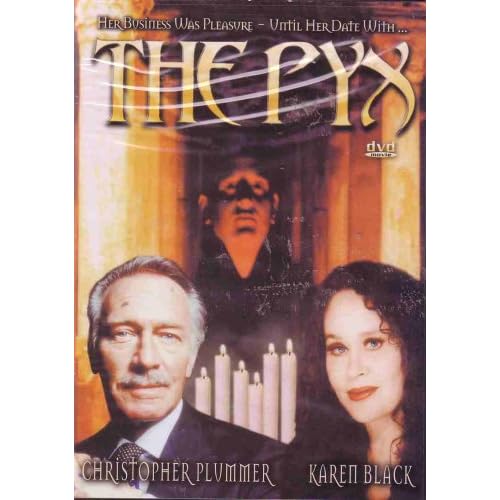
THE PYX (1973)

 
Canadian Det. Sgt. Jim Henderson (Christopher Plummer) is called to the scene of a death that could have been suicide or murder, and he’s leaning towards the latter. The body of a prostitute was found on the ground outside a tenement building, in one hand a necklace with an upside-down crucifix, in the other, a small round metal container on a chain. Henderson quickly learns that the woman’s name was Elizabeth Lucy (Karen Black), that she was a high-priced call girl working exclusively for a Montreal madam and that she had a relatively severe heroin addiction. Following his leads, Henderson’s suspects start turning up dead as well, murdered in perfunctory, if gruesome, fashion.
Parallel to Henderson’s investigation, we witness the last days of Elizabeth Lucy’s life. After an appointment with a regular John, she helps a younger and similarly-addicted hooker escape the life to a Catholic rehab clinic. Her madame, Meg, rewards her big-money score with a fix, then tells her about an arrangement with a real high-roller who’d asked for Elizabeth personally. She meets the reptilian Keerson (played by Jean-Louis Roux, actor, playwright, staunch anti-separatist senator and, according to Wikipedia, “briefly the 26th Lieutenant Governor of Quebec, Canada” ) on his private yacht, driven there by his personal driver. Keerson tells her to strip and then demands that she tell him personal facts about herself, her life and her background, leaving her more naked than she’s ever been.
Clues lead Henderson deeper into previously-unknown territory. The metal container, he learns, is a “pyx”, a lunette used by Catholic priests to transport a consecrated host to someone sick, in-firm or otherwise unable to physically make it to receive communion. Combined with the inverse crucifix, Henderson uncovers a Satanic cult, with Elizabeth right in the middle of an important ritual—one that may or may not have succeeded, depending on how Miss Lucy died. 
This is a pyx.
Based on the novel by Canadian author, John Buell, and directed by casual Star Trek director Harvey Hart, The Pyx is primarily a straightforward police procedural, naturalistic in the pattern of Serpico or The French Connection. The viewer is never an active participant in the investigation, always held back as if by some line of invisible police tape. We watch Henderson interact with his partner, Det. Paquette (Donald Pilon); we see him violently interrogate a frustrated suspect, but we’re not part of the mystery.
Conversely, we’re much more involved with Elizabeth’s story, drawn into her life with intimate close-ups, put at a distance only when Elizabeth closes off to the people around her—particularly when dealing with Meg—or when she’s shooting up. In these moments in particular, the direction is to make us feel like intruders.
The biggest problem with The Pyx as a film is with its structure. It isn’t readily apparent that the parallel storylines are subsequent, that we’re witnessing Elizabeth in a previous time, even though we’ve seen her lying dead beneath the opening credits. There are no visual or even textual indicators that we’re in the past when Elizabeth is on screen. When the body is identified as “Elizabeth Lucy”, then we’re introduced to the woman alive, then told of another hooker who has disappeared, at least I was duped into thinking that perhaps this was a matter of mistaken identity. The missing hooker was mis-identified as Elizabeth, her storyline was happening concurrently with Hendersons and at some point the two would come together. There’s a definite disconnect once the realization of time-shifting hits and it takes a while to get back onto track.
   Whether or not this was intentional on the part of the filmmakers is open to debate, of course. For my part, I had to stop after Keerson’s interrogation of Elizabeth and restart the movie to see where or if I’d missed something. It’s a definite misdirection and since the movie spent many years in the public domain (I first found it as part of a multi-disk horror collection), I started to wonder if this print was missing footage, or if this was a different edit entirely. A quick glance at a second “official” DVD told me otherwise; this was apparently the intended edit.
Strangely, the title character, the Pyx itself, barely figures at all in the movie. Little attention is drawn to it in way of close-ups; it is explained in almost off-hand dialogue (delivered by Pilon via clumsy American dubbing), and its signature scene, featured so prominent in the film’s trailers, is nothing more than a quick cutaway during the climax.
If the above weren’t enough to give one pause, there’s also the matter of Karen Black’s inconsistent performance, which is predominantly flat when she’s attempting to appear aloof and soul-dead. It’s difficult to tell when she’s supposed to be smacked-out and when she’s just shut off from Meg or another john. She only shines during her first scene with Keerson, and it really is a powerful sequence which left me feeling as emotional exposed as she was. On either side of this scene, however, it’s hard to generate any sympathy or concern for Elizabeth. She’s just not that interesting. (And speaking as one who could never get past Black’s wandering eye, which I’ve always found distracting—my problem, not her’s—Black never seems present in the film, as if she’s being directed by two conflicting points of view, but not in service of the character.) 
Christopher Plummer is Christopher Plummer. If you liked him in everything else he’s ever been in, you’ll like him in this. As Henderson he’s alternately determined or blandly appealing. The scenes were he attempts to be a tough guy fall flat. Pilon, for what little he has to do, is far more intimidating, possibly because his character is in service of the story and, as a result, a cypher.
As stated, there are multiple prints of The Pyx floating around, some under the title The Hooker Cult Murders and in various degrees of watchability. It’s actually pretty easy to luck out and land a widescreen copy on one of the numerous portmanteau collections, but there are also some dreadful full-screen copies as well, with no panning-and-scanning to speak of, so beware of versions focusing on tables with knees at either side. It’s an unusual movie and, at risk of being racist, a very Canadian thriller as well: low-key and lacking urgency, but getting the job done in the end. 

Wednesday, October 31, 2012

DRAG ME TO HELL (2009)


Christine Brown, a mild mannered loan officer—some may even venture to refer to her as “timid” or “wilting” or “generally terrified”—really wants the assistant manager position at her bank. Because her boss is played by David Paymer, she’s forced into a passive aggressive competition with another less-experienced but more minoritied co-worker, Stu Rubin (Reggie Lee), whose obsequiousness and under-handed-osity knows no bounds. Her boss tells her that the ideal candidate for that coveted position is someone who can “make the tough decisions”. Apparently, she’s been far too helpful and compassionate with her loans of late and it’s implied heavily that those attributes are frowned upon.

So enter Mrs. Sylvia Ganush, a fairly revolting and elderly Hungarian woman with one blind eye and an underwater-mortgage. While begging for an extension of credit, Mrs. Ganush coughs up gobs of lung into a stained handkerchief, places her false teeth on Christine’s desk and then empties the entirety of the mint dish into her purse. Since it’s easier to be compassionate to the non-disgusting, Christine makes the “tough call” and tells Mrs. Ganush that there’s no possible way to extend her credit any further. While that is not entirely true, let’s be a little realistic here. Ganush has already received a multitude of extensions and is obviously living beyond her means. Plus, you know: ew, slimy dentures on the desk! After receiving this news, Mrs. Ganush does what comes to her mind: first she begs on her knees then, when that fails, she attempts to strangle Christine.

Shaken but certain that she’d impressed David Paymer by surviving a gypsy assault, Christine leaves for the day. In the garage, the old bat attacks her again, in Christine’s own car! This in no way helps Ganush’s case and Christine is forced to defend herself with a Swingline, managing to even staple Ganush’s dead eye shut before kicking the car into gear and ultimately crashing. After getting kicked out of the car five or six times, the old gypsy finally gets what she came for: a button from Christine’s coat sleeve! With this button, she curses the loan officer and hands the object back.

Now, for all of Christine’s timidity and naivete and humanity, she does have the majority of her life together, despite the fact that she’s dating a guy played by Justin Long who collects coins. She brings him food, a rare coin she found in circulation (a 1902 nickel with an imperfection of George Washington making out with Abe Lincoln or something) (I’m kidding; it’s a “standing liberty” quarter, far less rare than the other one I described), and endures his side of a conversation with his mother where he’s obviously defending her past as an overweight farm girl. But after her near-fatal gumming by Ganesh, practicality is thrown to the wind. She drags Justin Long (who deserves no better than the character name of “Clay Dalton”) to fortune teller and world-famous-on-that-street mystic, Rham Jas (Dileep Rao, who would later play a mystical chemist in Chris Nolan’s Inception). Rham Jas confirms Christine’s greatest fears: Justin Long is a dousche. Oh and she’s also been cursed to Hell. A demon is coming for her to drag her there. Just like the title says!

Hysteria follows. Nobly following his contract, Long continues to support her by remaining her boyfriend, doing her no favors. The side effects of the curse include a horrible worksite nose-bleed that should have summoned squadrons of paramedics to her side but instead leave her coworkers staring in shock at this obvious hemorrhage like she’s a bleedy weirdo. Then her big account gets inexplicably dealt to another bank (could Stu be the culprit? Or one of the non-speaking-role co-workers?) so there goes her promotion. And apparitions of Ganush attack her often enough to make her seek out the old woman to make amends. In the course of this attempt at apology and plea for curse-removal, Christine of course stumbles over her own feet and destroys the now-deceased old lady’s wake, winding up under the formaldehyde-leaking corpse, much to the horror of everyone the crazy bat’s ever been related to.

Christine trys everything from kitten sacrifice to exorcism complete with goat when Rham Jas finally gives her the real secret: get rid of the goddamn button! But this is kind-hearted, at-the-end-of-her-rope-but-still-cartoon-sweet Christine we’re talking about. She can’t even bring herself to pass it off to people who have treated her most like shit—not Stu, not David Paymer, not even Justin Long (though, admittedly, the only reason he’d deserve it is for being Justin Long). So what’s the most logical next step for poor little Christine? Why dig up Ganush’s grave and give the button to her, of course. In the rain. In the dark. In her best clothes! If she did get dragged to Hell, Satan would probably wince, pat her on the head and send her topside for another chance, only to find her back in Hades a week later. “I offended another gypsy,” she’d say with an adorable shrug. 

 Look at him...Justin Long-ing all over the place.

For Evil Dead fans Drag Me to Hell was meant to be Sam Raimi’s long-awaited return to horror. After years of suffering beneath the yoke of Laura Ziskin and Spider-Man, Raimi wanted to tackle some more familiar ground, preferably free of Bruce “I’m on Burn Notice, mother-fucker!” Campbell. And while Drag Me isn’t quite the unrelenting gore-fest of the first Evil Dead, it shares the off-beat humor of Army of Darkness (and owes no small amount of debt to Night of the Demon). The gags are more gross-out than bloody, mostly involving Ganush spewing some liquid or semi-solid into Christine’s open mouth. Sam does manage to make a snotty handkerchief one of the scariest things to ever exist, though, and that’s among the reasons we all love him.

But at no time do you feel like Christine had this coming. In interviews, Raimi and his brother Ivan talked about wanting to do a story about an everyday, good-hearted person who does one act of cruelty out of selfish ambition and pays for it. Okay, if Christine had actually driven the bulldozer into Ganush’s house screaming “Assistant Manager, bitches!”, maybe the Brothers Raimi would have had something. But all the girl did was: her job. It’s practically analogous to Snow White slapping the poisoned apple out of the witch’s hand and getting squished by a dwarf-pushed boulder immediately after. Throughout the movie she’s presented as an eager-to-please little doormat who gets more than her share of flaming shit bags dropped on her, and for that she’s doomed to Hell?

You can’t help but wonder if all that Marvel Comics money went to Sam’s head, because what he basically made was a Mitt Romney morality tale with Christine representing small business and Ganush standing in for the filthy 47%. I mean, here’s this poor, sweet, innocent woman in charge of the economy being bullied by a gross, grotesque, filthy and possibly undocumented elderly woman who’s demanding more credit, even though she hasn’t earned it. In point of fact, Ganush feels entitled to her house because she’s lived there for thirty years. “Never missed a payment until the sickness took her eye,”—yeah, right. And what were you doing that got you so sick, Mrs. Ganush? Probably some unhealthy lifestyle, and now she’s no doubt on welfare, lying around and sucking off the welfare teat! Little Miss Golden Haired bank person has her hands tied by the system, and even if they weren’t, she was looking to advance her position through hard work and personal responsibility. Is that so wrong? Why should she be punished for ambition and Ganush rewarded for being a drain on the American taxpayer? Besides, Christine said that she wanted to help her, isn’t that enough? Apparently not for this godless, toothless semi-foreigner who inflicts nothing but hardship on poor, poor Christine (innocent of all wrongdoing except for the misguided love she feels for a filthy liberal academic who collects—sorry, hoards—rare coins).

 Direct, Sam! Direct like the wind!

While Drag Me to Hell is a worthwhile roller coaster ride, complete with all the wild Raimi angles and the chaos that gleefully Evil Deads all over the place, from a thematic point of view, the crime really doesn’t fit the punishment. Even the most judgmental horror movies—if you have premarital sex you die; if your parents do something evil you die—would find fault in Drag Me’s premise. Maybe if Christine had more bite to her—instead of doe-eyed Allison Lohmann they’d cast Eliza Dushku, who could have at least hinted at a dark side, or even better, if they’d cast Lil’ Miss Blankface, Kristen Stewart—we could root for Christine’s inevitable Hell-dragging-to.


Tuesday, October 30, 2012

And we're back...


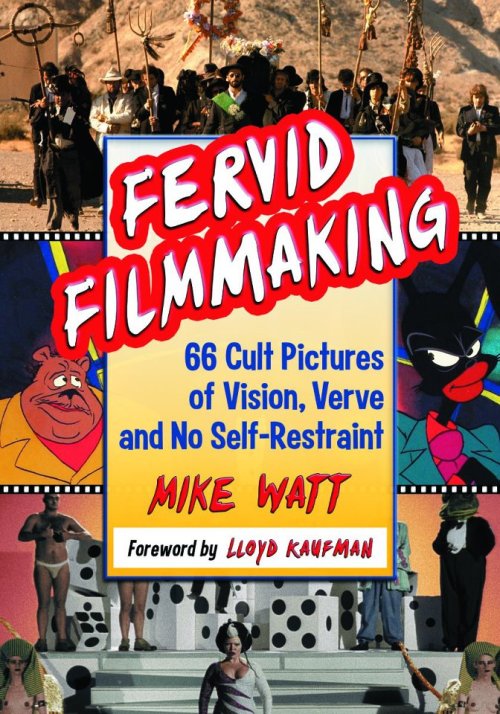
Apologies to my thousands of loyal readers. I had to take some time out to write this upcoming book!


You can pre-order it from Amazon here:

http://www.amazon.com/Fervid-Filmmaking-Pictures-Vision-Self-Restraint/dp/0786470666/ref=sr_1_1?ie=UTF8&qid=1349213718&sr=8-1&keywords=Fervid+Filmmaking

And then Like us on Facebook:
https://www.facebook.com/FervidFilmmakingBookMikeWatt

And more great and wonderful pieces coming very soon!

Wednesday, October 19, 2011

DRONES (2010)


Dilbert, The Drew Carey Show, The Office and Office Space have worked hard over the years to shatter the illusions built up by pro-Capitalism extravaganzas like How to Succeed in Business without Really Trying and Cash McCall. Modern entertainment has proven that corporate-culture office work can be more monotonous and soul-crushing than the first few weeks of military boot camp, certain to leave you a dry and empty husk alone in your cubicle. “Can be”, obviously; much different than “is”. Drones is the anti-“is” in this situation.
The cubicle civilization depicted in Drones is comprised of more or less comfortable workers. Unchallenged though they may be in most aspects of their lives, in and out of the office, the employees of Omnilink are not merely enduring their work-day. They work reasonably-hard doing reasonable tasks and at the end of the day, they go home. Even the artificial crises that pop up—the decreased lead time, the looming deadline—do little to jolt them from their routines. A key element in their daily existence is gossip, and that fills the space between forms and databases. Who is sleeping with who—the essential and possibly only ingredient. If Ian is such a creep, why does Miryam keep taking him back? When will Brian ever ask out Amy? These are the distractions from the database that corporate switched unwisely from its chronological to alphabetical structure. Discussions take place right out in the open because, well, the water cooler doesn’t work.

Encouraging the romantic pairing of Brian (Johnathan M. Woodward of Buffy and Firefly fame) and Amy (cult goddess Angela Bettis) is the centerpiece of Drones, setting the movie’s low-key catastrophes into motion. Office romances, you see, are discouraged by management for a reason. Breakups can lead to hostile working conditions or worse: galactic destruction. At best, it’s a distraction, so everyone would be better off keeping things professional. Unless you want a hostile race of aliens marking the human race for extinction and blowing up the whole planet? You don’t want that, would you? Bad for business.
Directed by Buffy co-stars Amber Benson and Adam Busch, Drones is a dry, droll comedy that has managed to fly under the radar for most of the film-going public. Well-received at Slamdance in 2010, theatrical exposure eluded it because of its very underemphasized nature. Critics dove into their thesaurus of clichés and hauled out that old indie standby, “quirky”, and slapped that appellation over every review. The problem is that Drones is not “quirky”. “Quirky” was coined for movies like Nick and Norah’s Infinite Playlist and 500 Days of Summer and anything starring Zooey Deschanel or Parker Posey (the ‘90s version of Zooey). Drones on the other hand is quite the opposite of “quirky” as it’s the most perfectly-deadpan movie to come along in such a long while.

The strong script by Ben Acker and Ben Blacker (yes, I know; shut up) posits the time-tested hypothesis that aliens walk among us and in Men in Black fashion, they’re prepping reports, Xeroxing documents and shuffling data along with the rest of us. Opening with a Powerpoint presentation that will evoke dread in anyone who has ever endured the real thing, Drones’ company Omnilink is compared to a hive, with each member playing its part for the betterment of the colony. “A bee uses its tongue to extract pollan from a flower. We at Omnilink do the same thing. We use our tongues daily, but over the phone.”

The company’s interpersonal strategy: “The buzz of a job well-done is 1) keeping your cool; 2) reaching out; 3) and interacting with others.” Co-operation is vital and everyone should do their part by visiting neighbor’s cubicles, chatting—“Say, Bob, wasn’t that a great Powerpoint presentation Peter gave this morning?” Human relationships invigorate the hive.

Which is why everyone from supply-closet king Clark (Samm Levine) to spreadsheet crusader Cooperman are pestering Brian to ask out Amy. Not that he sees any problem with that. They’ve flirted in the past, but there are doubts. “She uses capital letters in her I.M.’s,” explains Brian. “I’m more of a lowercase kind of guy.”

“Tut,” tuts Cooperman. “Relish your differences; they're as important as your sames.”
Despite the shock of catching Clark “communicating” in the supply closet and revealing that he’s an alien, Brian retrieves a box of staples and delivers them to Amy. Then pops the question. Which envokes an extremely logical response. “You’ve asked me out in return for bringing me staples. It seems…disproportionate.” But they give it a shot, meet for drinks after work and over the weekend agree that they’re “dating”. Brian hardly gives Clark’s revelation a second thought.

By Monday, Amy is so excited about their new status as a couple that she drops her own bomb on Brian: She, too, is an alien, a race called Soyka, and the copier isn’t her “pet alien robot” but a communication device through which she talks to a co-worker (Jafe) on her own planet (Elg). But this, on top of Clark’s news and the sudden pressure of dating, makes Brian freak out. Unlike Clark’s people, who merely want to enslave the human race—

Clark: Nothing will really change except that I’ll be your boss.
Brian: Can I get a raise?
Clark: Sure!
Brian: Then I’m good.

—Amy’s people want to destroy the planet for fuel. But that plan is on hold “for now”. Brian’s reaction, though, drives a wedge between him and Amy and by lunch they’re no longer dating. The next day, he preps a Powerpoint presentation in which he uses a bar graph to declare that “Amy Is A Jerk”. Still getting used to her new human emotions, Amy doesn’t take well to this sort of thing, particularly as it had nothing to do with the new Planicka account and just serves to extend the meeting. So she contacts her people and tells them that it’s time to move up the deadline. The armada, she is told, will be there sometime after lunch.
Drones pulls this oddball story together with the conceit that, like any other office, this imminent disaster is met with the same urgency as any other client demand. Not only does everyone accept Clark’s and Amy’s extraterrestrial identities in stride but they pull together to help figure out the problem before the planet is destroyed or they have to work overtime. And with this approach, Benson, Busch, Acker and Blacker manage the ultimate triumph of zero cynicism.

Unlike so much of our entertainment, particularly in the realm of “indie” or “quirky”, the Omnilink drones are not the oppressed creatures from Office Space, comprised only of tension and teeth. Drones isn’t about revenge on corporate America but instead tackles the old fashioned notion of doing your job and going home. As ironic a term that “post-ironic” has become, that’s precisely what Drones is about. There’s no winking at the audience, no elbow-nudging or cooler-than-thou posturing. It asks, quite literally, what would you do if you found out a co-worker you liked and thought you knew was going to destroy the planet where you keep all your stuff? Would you go hysterical and attack her with a paper cutter? Or would you just try to talk her out? Because neither is going to make 5pm come any sooner and one seems like it would take more effort than the other. What is the corporate cubicle-jockey’s path of least resistence? And could it be done through interoffice email?

So many things could have scuttled Drones. In the hands of showier directors with something to prove, this alien-invasion-cum-coffee-break could have gone over-the-top, bug-eyes, hysterical mugging, punchlines with the extra punch. But Benson and Busch handle the material with knowing restraint. Even when Brian is at his most hysterical, Woodward’s performance barely raises beyond pitched incredulity. The movie they made is not about madcap artificiality and because of their mature approach Drones is delivered with likable characters and funny material. Nothing is ruined in the name of appeasing the Hollywood over-the-top machine. Which, of course, is why it was deemed an impossible sell.

As of this writing Drones is only available through Amazon’s on demand streaming service or through extended cable (I happened to catch it during a free weekend of Showtime). Reviews for the film thus far either stuff it into the aforementioned “quirky” category or dismiss it outright as a “nothing new indie thing”, citing the amusing score by Jonathan Dinerstein and Dan Bern (and Busch’s band Common Rotation)—especially the appropriate opening song “Strongly-Worded Memo”—as pretentious “prog-rock. (But again, that’s the too-cool-for-you crowd for you, and forgive me if I’m wrong, but isn’t being a hipster no longer cool? Or being knowingly uncool make you cool?) If you can watch it without falling prey to your own misconceptions of what a “festival movie” is or is not, you might find yourself charmed by Drones’ quiet story about humanity, aliens and spreadsheets.

Hail Soyka.

Wednesday, September 21, 2011

THE SWORD BEARER (2010)


“Dude,” as I was addressed by a handful of people, “did you see that new Russian superhero movie, yet?”

I hadn’t. “What’s it called?”

“Mechano-something. I don’t want to give anything away but it’s awesome! The camera is all over the place and the effects are great.”

This was relayed to me a number of times over a period of about ten days. The description always vague and usually leaving me with less information than I had going in. Finally, one of these good Samaritan dudes (and one dudette) included an IMDb link to a movie called The Sword Bearer, aka, in Russia, Mechenosets. Based on writer Yevgeni Danilenko's book, directed in 2006 by Filipp Yankovsky, The Sword Bearer turned out to be something different from what was described. I suspect that these well-intentioned friends were trying to steer me towards the flying-car movie Black Lightning, produced by Timur Bekmambetov, or maybe even Bekmambetov’s Daywatch, because what I got with The Sword Bearer was not a slam-bang actioner, but a very quiet and occassionally disturbing story about a young man who has been ostracized by society for a unique flaw in his genetic make-up.

Unfolding slowly and deliberately, we are gradually introduced to Sasha (a remarkable Artyom Tkachenko), a withdrawn little boy who grows up to be an isolated teenager, shunned by many who know him because of his temper and the violence that results from it. When Sasha feels threatened, a gleaming, indestructable metal blade extends from his wrist. With it, he can cleave stone and wood as easily as flesh and bone, and he doesn’t seem to have the ability to control it, or even set it on “mild injury” much less “stun”. However, he doesn’t pop the blade like Wolverine; the sword bursts painfully through his skin, sometimes skewering the palm of his hand, leaving behind a bloody appendage he does his best to hide with bandages.

Returning to his childhood neighborhood after an unexplained absence, the adult Sasha happens across a girl he knew from school. Her mobster’s son boyfriend and his droogs arrive and beat the young man down in the street, then drive off in their flashy Yay-Capitialism sports car. Tracking them back to her home, Sasha uses a rusty pipe to destroy the car with the bullies inside, killing or severely injuring each one. Shocked by his violence, the girl withdraws and Sasha runs. The next morning, the boyfriend’s connected mother puts a price on Sasha’s head.

In a new city, he meets a woman about his age, Katya (Chulpan Khamatova). They bicker in a stairway then fall into each others’ arms, anger fueling passion. Then her lover arrives home. Instead of offering any explanation, Katya orders the man out of the house. When he attempts to shoot her, Sasha breaks a chair over his head and they leave him tied up. Once freed and out for revenge, he attempts to rape her in the back seat of her car. Sasha’s rescue of her is brutal and horrifying, even to himself. Slamming the would-be rapist overhand into the car’s windshield, Sasha straddles him. Without his bidding, the blade extends and leaves the man bloody and dead, half in and out of the car. Shocked and shamed, Sasha runs and the girl comes up behind him, watching him press the blade tip into the pavement to force it back into his body. 

The brutality and revelation is too much for her and she collapses. Sasha takes her home and she wakes up terrified of him. He hands her the phone, tells her to call the police, but she can’t.

It’s at this very point that you realize that this will not, cannot end well for either of them. This is a movie borne of a tragedy with all the classic tropes—misunderstood hero, doomed lovers, society mistaking iconoclasts for the mentally ill, the disease of revenge—all distilled into an odd little metaphor that is rarely even visual. The blade represents Sasha’s isolation, his barely-controlable rage; the bloody path left behind him are predominantly accidents—just as the first time, as a child, when he defended his mother by murdering his stepfather; when he protected a schoolmate from an escaped prisoner. First we see the wooden sword in young Sasha’s hand, then the bloody corpse on the floor.

Restrained and disciplined, Yankovsky never allows The Sword Bearer to dab even a toe into X-Men territory. Preferring to show the aftermath of Sasha’s emotions, at no point does the director attempt to ape western testosterone set pieces. We never see, for example, Sasha racing down a hall, blade extended, mowing down assailants. (The best we gorehounds get is a shot at the rear of a police van, a cascade of blood spilling through open doors and around Sasha’s boots, once belonging inside the half-dozen men escorting him to prison.) He’s not a superhero; the blade isn’t a curse. It’s just a part of him he doesn’t understand. He can’t even extend it at will, to prove his story to a policeman who is eager to hear any rational explanation. When it does emerge, he can cross-cut forests, cleave tractor trailers in half. Even then, Yankovsky keeps the blade obscured by action, more a force than a weapon. When we watch Sasha slice off the tail of a helicopter, we realize that the blade’s length is as infinite as his rage and grief, and many more times powerful.

Going into the film blind, The Sword Bearer became for me a very pleasant surprise, but one that demanded my attention (and not just because all the subtitles were about a full-second off, making following the subdued story even more difficult). Not everything is explained but then not every detail is necessary. All we have to no that a very special man is in love with a very special woman, that they’re both damaged in their own way, and that the world is a cold, hard place that has no interest in understanding them. It’s a very simple story wrapped up in an atypical narrative.

Depending on your own tolerance for deliberately-paced movies (what some may call “boring” and not unjustified), you’ll either find The Sword Bearer remarkable or intolerable. And for this reason, in addition to the subtitles and the presence of actors who may be acclaimed in Russia but are virtually unknown here (until they’re hired to play thuggish villains for the next Jason Statham movie), Mechenosets did not receive a wide release in the U.S. It played festivals in the big cities but was not released on domestic DVD. But even abroad, the pacing and open-ended questions, primarily concerning Sasha’s origins and any explanation of the blade, have left many viewers frustrated.

It’s at this point in the review when I suppose I should ask, pretentiously, if subtlety and allegory have been completely bred out of our DNA, regardless of location. Because I found meaning and satisfaction instead of explanation doesn’t raise me above or place me below another viewer. The Sword Bearer is a story about a scream told in a whisper. Whether you dig it or not will depend on how loudly you want to hear a story like this and when you’re willing to hear it.