
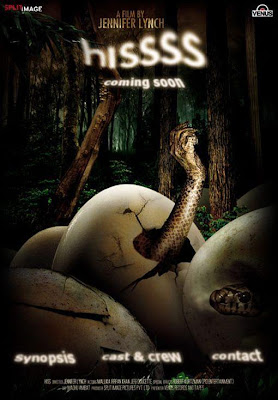
This legend, depicted in the film’s prologue, provides the background for Hisss , a new film directed by Jennifer Chambers Lynch (Boxing Helena). Set in modern day India, the story begins with an American named George States (Jeff Doucette) who is suffering from late-stage brain cancer and seeks the Nagamini in a last desperate attempt to save his own life. He and his hired mercenaries track down the Nagin while she is entwined around her mate. Separating the two snakes, George makes off with the male, leaving the female Nagin to thrash in anguish (as much anguish as can be depicted by a snake, anyway). Knowing the Nagin will follow, George and his fearful thugs take the male back to their underground bunker of a lair and wait for the snake goddess to make her move.
, a new film directed by Jennifer Chambers Lynch (Boxing Helena). Set in modern day India, the story begins with an American named George States (Jeff Doucette) who is suffering from late-stage brain cancer and seeks the Nagamini in a last desperate attempt to save his own life. He and his hired mercenaries track down the Nagin while she is entwined around her mate. Separating the two snakes, George makes off with the male, leaving the female Nagin to thrash in anguish (as much anguish as can be depicted by a snake, anyway). Knowing the Nagin will follow, George and his fearful thugs take the male back to their underground bunker of a lair and wait for the snake goddess to make her move. Meanwhile, police inspector Gupta (Slumdog Millionaire ’s Irrfan Khan) is dealing with the chaos of Holi—the springtime “Festival of Colors”, a holy carnival celebrated en masse by dancing, reveling and spraying colored paint over everyone and everything. He and his wife (Divya Dutta) have tried desperately to conceive a child, only to result in miscarriage (the worst and most-recent coinciding with George’s kidnapping of Nagin’s mate). His job is stressful, his marriage troubled, his live-in mother-in-law demented (she refers to him as her “other daughter” and berates him for being too ugly for a man to want), Gupta is beleaguered.
’s Irrfan Khan) is dealing with the chaos of Holi—the springtime “Festival of Colors”, a holy carnival celebrated en masse by dancing, reveling and spraying colored paint over everyone and everything. He and his wife (Divya Dutta) have tried desperately to conceive a child, only to result in miscarriage (the worst and most-recent coinciding with George’s kidnapping of Nagin’s mate). His job is stressful, his marriage troubled, his live-in mother-in-law demented (she refers to him as her “other daughter” and berates him for being too ugly for a man to want), Gupta is beleaguered. Meanwhile, the Nagin transforms herself overnight into a beautiful woman (played by Mallika Sherawat). Mute like her snake form, Nagin is confused at first about the human world. She steals a sari to cover herself and makes her way into the city. Once there, she is caught up in the Holi and finds herself captivated by the rhythmic music. Distracted, she is led away by two young punks who intend to rape her. It should go without saying that attempting to rape a snake goddess is way at the top of the List of Very Bad Ideas. Later that day, Gupta is summoned to the blood-soaked flat and surveys the remains of the two punks. One is full of very large holes. The other is little more than a lump of meat, gristle, bone and fabric—as if his body had been regurgitated by a very large snake. Gradually, the stories of Nagin, Gupta and George intertwine, leading to an appropriately gruesome (but surprisingly low-key) climax.
Here’s the part of the article where I admit to having almost no experience with the cinema of “Bollywood”. During my research, I discovered just how deeply my ignorance runs as “Bollywood” refers only to Hindi-language movies, while Tamil-language films from Sri Lanka fall into the categories of “Jallywood”, while Indian Tamil cinema is referred to as “Kollywood”. Therefore, I am not only unfamiliar with one subset of the largest output of films in the world, but also two others. This realization was, to say the least, very damaging to my ego and is rectifying this is sure to suck up a lot of free time in the future.
My lack of education in this area meant that while I knew Irrfan Khan looked familiar (due to his appearing in Western films like A Mighty Heart and particularly Slumdog), I’m more versed in the ouvre of Newhart’s Jeff Doucette (he played “Harley”, the chronically unemployed goof). I was even less familiar with the beautiful Sherawat, who is gradually breaking through in Hollywood by co-starring (for good or bad) in Jackie Chan’s The Myth and William Dear’s upcoming Politics of Love (aka Love, Barack). And while my innate nerd provided me a passing knowledge of the “Naga” animal people (not primarily snakes) of Hindu culture, I was completely ignorant of the previous Indian films detailing the story, including Nagin (1976), Nagina (1986) and it’s sequel Nigahen (1989).
and William Dear’s upcoming Politics of Love (aka Love, Barack). And while my innate nerd provided me a passing knowledge of the “Naga” animal people (not primarily snakes) of Hindu culture, I was completely ignorant of the previous Indian films detailing the story, including Nagin (1976), Nagina (1986) and it’s sequel Nigahen (1989). In truth, Hisss may have escaped my attention entirely were it not for my slavish devotion to special effects artist Robert Kurtzman, who designed the Nagin’s transformation and half-snake/half-human appearances. (On a personal note, I got to see some of these early designs in person during a visit to Kurtzman’s studio – I mention this only because I think it’s cool and I like to work it into casual conversation.) After Lynch Jr.’s disastrous Boxing Helena and the irritation Surveillance, were it not for Kurtzman’s involvement, I may have given Hisss a misss (sorry, couldn’t resissst) entirely, giant snake-woman or not.
While there is a rather beautiful partially-diagetic musical number set during the Hori, with Sherawat front and center of the dance amid swirling silk and spraying color, the emphasis in Hisss is definitely on the horror/mystery aspects, so the movie leans more towards the effects end of the spectrum. That being said, while Kurtzman’s practical makeup—the costume, prosthetics and larger puppets—are extremely satisfying for the horror geek, the CGI bounces along the “okay” to “what-the-?” on this harshly-scored scale. Keen-eyed effects hounds will also notice, very quickly, when Lynch’s direction lets the effects down, particularly during shots of the beautifully-crafted male snake puppet (the film is quick to point out at the beginning that no live snakes were actually used). Perhaps this can be shoved onto the shoulders of editor Tony Ciccone, but an editor can only work with what he’s given.
On the other hand, there are numerous “quiet” moments of both horror and beauty, particularly a standout scene where a naked Sherawat slithers up a lamp post and sleeps beneath its warmth. Khan’s fleeting moments with Dutta as they address their strained marriage also packs tiny gut punches unmatched by event the most glorious of gore (and an autopsy of the regurgitated lump of rapist is especially nasty—praise be to Ganeesh).
A quick view of the IMDb reviews reveals that Hisss was not well-received in its initial Indian release, with many reviewers from that part of the world denigrating it as “low-grade” and a “B-Movie” unbefitting of an actor of Khan’s stature. High marks are given all around to Sherawat’s body, but little is made of her nearly-silent and wonderfully communicated performance as the bewildered “Ichhadhari Nagin” in human form. One reviewer was confused as to the film’s setting, due to a number of different dialects spoken on-screen. When Hisss is finally released in the U.S., this is unlikely to be a problem, as Lynch shot the film simultaneously in English and Hindi and it’s not like many of the unwashed horror fans will catch the difference between Malayalam dialect of Kerala and the more-common Hindi speech of Mumbai. I certainly didn’t, though I did chuckle at the Hindi-dubbed voice of Doucette, expecting the “dum-de-dum” voice of Harley. But that’s because I am, sadly, a member of the unwashed Ugly American horror masses. (Another chuckle came from the fact that Hisss utilized the “studios of Filmistan”, which sounds like something Garry Trudeau would invent. I know, I’m a bad person.)
The version of Hisss I was fortunate enough to view was a Hindi-language foreign press screener DVD. There is no word on the film’s official website when—or if—there will be an American release. If one does not surface, it will be an honest shame because I, for one, am grateful to Hisss for opening the doors for me to Indian cinema and I think it’s a perfect introduction to that world for similar horror fans. No matter what the language or culture, nearly all of us appreciate a gorgeous girl who can turn into a giant snake. It’s one of those common loves that keeps this wonderful world turning.

Marketing Department: Why use this:

When there's something as boring as this available?


