Showing posts with label stage play adaptation. Show all posts

Tuesday, December 18, 2012

THE MADWOMAN OF CHAILLOT (1969)

-->
“This is the story of the triumph of good over evil,” we are told by the opening titles. “Obviously it is a fantasy.”
It is said that Molière and La Fontaine used to frequent the Cafe de l'Alma in the Chaillot district of Paris. But today it is visted by a group of leaders, including The Chairman (Yul Brynner), The General (Paul Henreid), The Commissar (Oskar Homolka), and The Prospector (Donald Pleasence), who privately refers to them as, “Just faceless, ordinary monsters.” Together, they form the Board of Directors of International Substrate, and they have hatched a plan to dig up Paris in order to get to the oil that lies beneath the city.
Now, it is well known that all districts of Paris have their own dotty protectors, the Madwomen, if you will. The titular "Madwoman of Chaillot" is Countess Aurelia (Katharine Hepburn, in her best performance as far as I'm concerned), who prefers to live every day as one specific date. “First, the morning paper. Not these current sheets full of vulgar lies. I always read the Gaulois for March 22, 1919. It’s by far the best. Delightful scandal. Excellent fashion notes. And of course the last-minute bulletin on the death of Leonide Leblanc. She used to live next door. And when I learn of her death every morning it gives me quite a start. To recover from which, Chaillot calls. It is time to dress for my morning walk. That takes much longer without a maid . . .”
She’s not so mad as to imagine that life really is the same as that one March morning. Time is passing, of course, but it’s not like she has to acknowledge it. “Of course, in the morning it doesn’t always feel so gay. Not when you’re taking your hair out of the dresser and your teeth out of the glass. And particularly if you’ve been dreaming that you’re a little girl on a pony looking for strawberries in the woods. But then comes a letter in the morning mail. One you wrote to yourself, giving your schedule for the day. Then, when I have washed in rosewater and put on my pins, rings, brooches, pearls, necklaces, I’m ready to begin again.”
The Prospector’s son, a radical activist named Rodrick (Richard Chamberlain), brings the Board’s scheme to the attention of the genteel lady, as well as her cadre of peers, including the waitress Irma (Nanette Newman), the Folksinger (Gordon Heath) and her most confident of confidants, the Ragpicker (Danny Kaye). “The world is being taken over by the pimps,” says master Ragpicker.
The Countess is appalled, “The world is unhappy? Why wasn’t I told?”
So distraught is she by this news of scheming, of men living life as if it was disposable, Countess Aurelia gathers the other Madwomen of the districts—Josephine, the Madwoman of La Concorde (Edith Evans), Constance, the Madwoman of Passy (Margaret Leighton), (Josephine, the Madwoman of La Concorde (Edith Evans), and Gabrielle, the Madwoman of Sulpice (Giulietta Masina). Together with the street people, her people, she desides to hold a trial for these despoilers, in absentia. The rich men and their destructive ways are represented by The Ragpicker.
“Criminals are always represented by their opposites,” assured Josephine, who was to be the judge. The trial was absolutely necessary, for something had to be done.
“If you kill them, they’ll be missed,” protested Constance. “And we’ll be fined. They fine you for every little thing, you know?”
To which the Countess replies, “Do you miss a cold when it’s gone? They’ll never be missed.”
Thus, the Ragpicker prepares the case, defending against the charge that he and his ilk worship money.
“Worship money? Me?” says the Ragpicker. “I plead not guilty! I don’t worship money. It’s the other way around. Money worships me. It won’t let me alone. The first time money came to me, I was a mere boy. Untouched. Untainted. It came quite suddenly when I innocently picked a bar of gold bullion out of a garbage can while playing. As you can imagine, I was horrified. I tried swapping it for a little, rundown one-track railroad. To my childish amazement this immediately sold itself for a hundred times its value. I made desperate efforts to get rid of this unwanted wealth. I bought refineries, department stores, every munitions factory I could lay hands on. The rest is history. They stuck to me. They multiplied. And now I am powerless. Everyone knows the poor have no one but themselves to blame for their poverty. But how is it the fault of the rich if they’re rich? Oh, I don’t ask for your pity. All I ask for is a little human understanding.”
He continues, “Ah, without money nobody likes or trusts you. But to have money is to be virtuous, beautiful, honest and witty. To have none is to be ugly and boring and stupid and useless.”
“One last question,” asks the Countess. “Suppose you find this oil you’re looking for? What will you do with it?”
“I’ll make war! I’ll destroy what remains of the world!”
When the trial concludes the verdict is clear: guilty. But how to carry out the sentence, and what shall the sentence be?
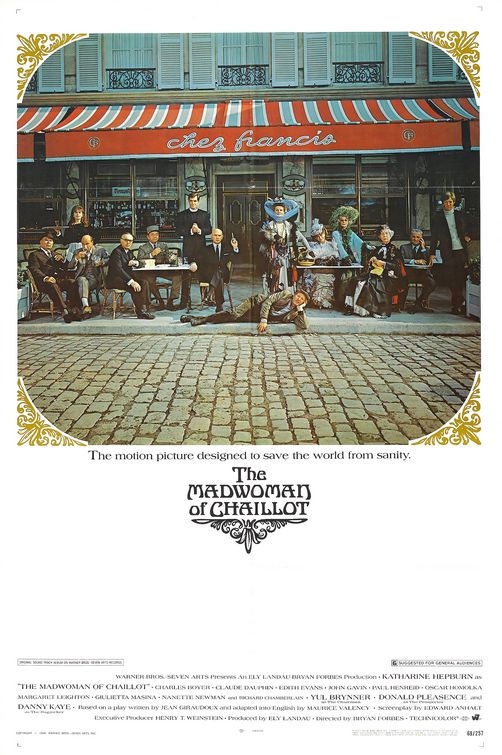
The Madwoman of Challot began life as the play, La Folle de Chaillot, written by acclaimed writer Jean Giraudoux and was first performed in Paris in 1945, a year after his death. In 1949, fellow playwright Maurice Valency adapted the story into English and it was warmly received in the United States. Subsequently, the play was reworked by Inherit the Wind authors Jerome Lawrence and Robert E. Lee (with music and lyrics by Jerry Herman) into the musical Dear World, which won star Angela Lansbury a Tony Award. That same year, 1969, screenwriter, producer and pulp writer (with wife Edith), Edward Anhalt (The Boston Strangler), adapted the Valency script for the big screen, which was directed by Bryan Forbes (Séance on a Wet Afternoon). The film premiered in October, was met with favorable reviews from critics and not-too-shabby attendence, then quietly bowed out of the limelight, fading away with the final breaths of the “Summer (and Autumn) of Love”.
Anhalt’s screenplay adheres closely to Giraudoux’s play and embellishes only where he needs to. Just the same, spending the first act with the odious Board members gets a little tedious. While it is indeed fun to watch Brynner rail against the indignities he must suffer every day when exposed to the world’s rabble, the sequence becomes a slog. After about ten minutes, you’ll catch yourself saying, “I get it. They’re evil, cruel capitalists. What else is new?” But if you can stick with the movie until Hepburn’s marvelous Countess is introduced, the movie becomes a delightful ride from there. Until it slows down again with the introduction of the other Madwomen. Their first scene together unfortunately drags as well, mirroring the Board’s callousness with their own fractured-mirror outlooks on life. But the reward for coming this far is without question Danny Kaye’s moment as the Ragpicker during the trial. Assuming the collective persona of all cruel overseers and misers, the Ragpicker seems to shock himself by the end with the imperious self-righteousness he finds within. It’s a chilling moment of black comedy and the centerpiece of the film (as, I’m sure, it was the centerpiece of the play) and Kaye left me breathless, at least. 
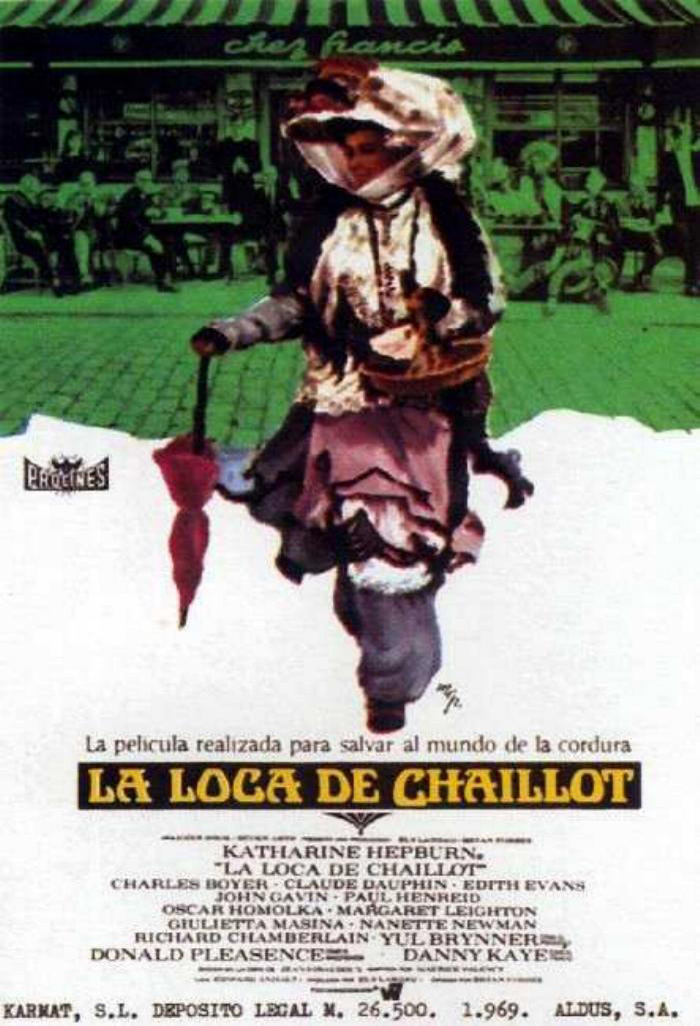
 
The particulars of The Madwoman of Chaillot are, unfortunately, timeless. The rich will always run roughshod over the poor and life is wasted on the forward-thinkers, only appreciated by the young and the mad. And while the underlying themes are also universal, this particular movie seems more appropriate today than it might have in the post-war Paris of the ‘40s or mid-war America of the late ‘60s. The Madwomen and the street people, including the idealistic Irma and Roderick, could easily fit the mold of the modern “Occupy” movement; the Board of Directors are an easy surrogate for Wall Street and Corporate Culture. As the opening title card points out, almost bitterly, the results are pure fantasy.
While Anhalt invented scenes involving The Prospector and his son inside their home (where Pleasance’s character collects and displays old bathroom doors, hanging them on the wall as modern art), they wisely resisted the temptation to update the play for modern times. The Café and the Countess’s domiciles exist in stasis, the first eternally quaint and the latter decaying along with its owner’s mental stability, yet still retaining its dignity. Certainly Roderick and the Board members are given a more modern cut of suit, no hippies or swinging Londoners lurk in the background of the frame. The story stays put in its fantasy time period and could be easily trotted out for any generation.
Unfortunately, it really could be applied to any generation, as class warfare is less cyclical than it is a never-ending hypno-spiral. But how lovely would it be if we could just round up our ruthless rulers, bankers, despoilers and pimps and just march them off the end of the Earth? It’s of course an insurmountable solution. The best we can do is get up, dress up in our best, and pick a personal time from our past where life was perfect, without the simple evil of reality shattering our illusions of happiness.
For therein lies the true tragedy of The Madwoman of Challot: in the end, the Countess’s world has been intruded. Tomorrow may again be March 22, 1919, but it won’t change the fact that yesterday was quite gloomy, cold and hard.
Again, we must bow our head in silent prayer to the Warner Brothers Archives for preserving this handsome oil painting brought to life (thanks to the photography of Burnett Guffey and Claude Renoir). At the moment, it’s available as one of their movie-only standalone DVD-Rs, but it’s better than nothing at all. Amazon also has made it available on their Instant Video Service.
For another take on the story, be sure to check out the novelization on Richard Chamberlain’s website.




Tuesday, November 27, 2012

KILLER JOE (2012)

 
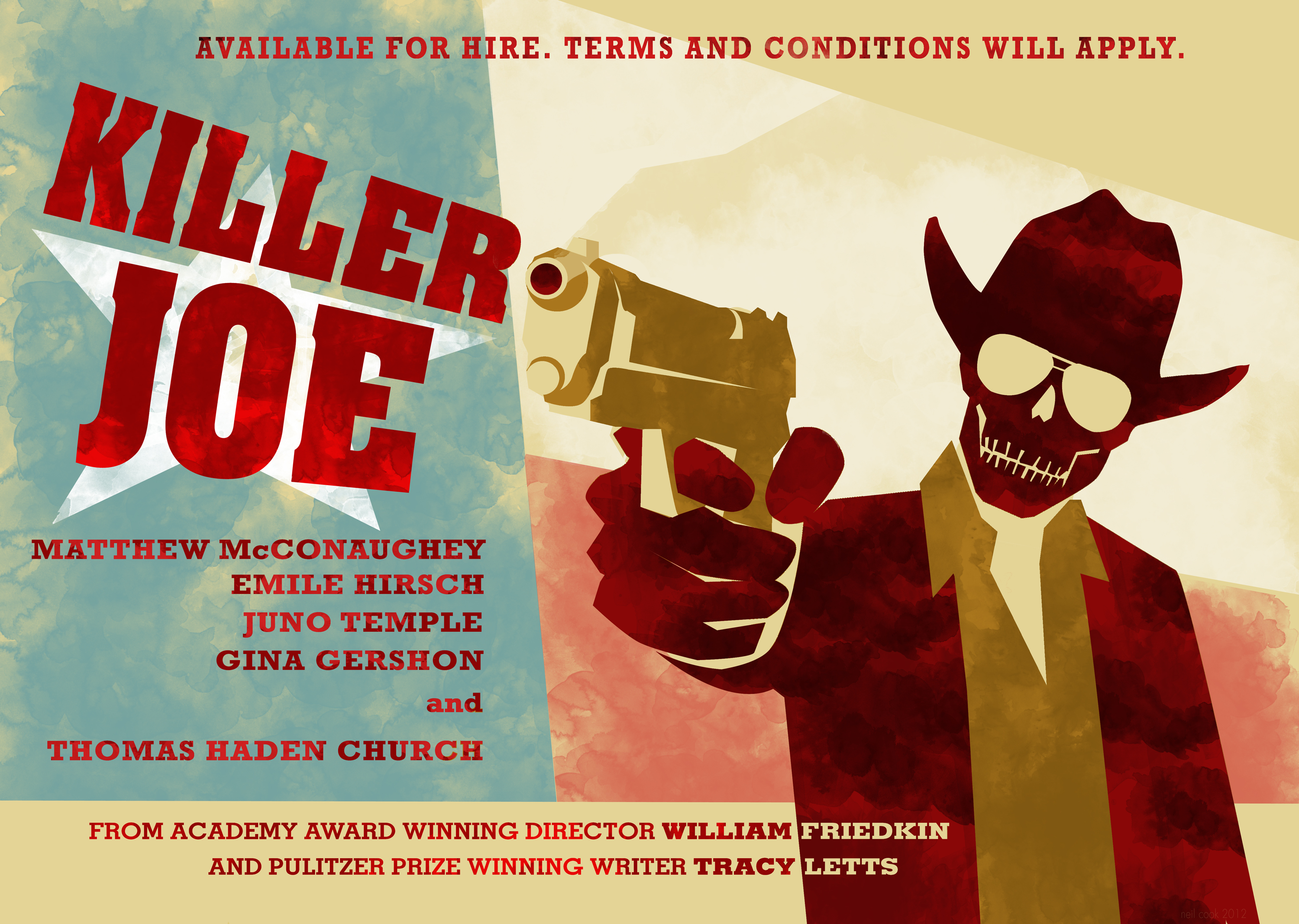
One of the most difficult things to learn as a critic of any kind is objectivity. Most critics fall victim to their own preconceived notions at some point in their careers. In many cases, it’s because the movie they watched isn’t the movie they expected to see. The most blatant example I’ve ever seen was from a reviewer who gave the low-budget indie adventure Project:Valkyrie a lousy rating because he, for whatever reason, expected giant fighting robots in the movie, instead of the lone man-sized one that was actually in the film. (Above image found at http://www.behance.net/gallery/Killer-Joe-typography-and-poster-concept/4037639)
In a perfect world, all critics would approach every piece of art with an open mind, judging it only against itself in terms of success or failure. But since critics are human beings, and our knowledge is based on past experiences, that approach will never happen, so we have to rely on intellectual filters to avoid bias. If, as a critic, one can attain self-awareness and avoid self-righteousness, then your reviews will reflect fact and opinion honestly.
Obviously, this isn’t just the failing of critics. Everyone dislikes at least one movie for not being what they expected. I’m just as guilty as anyone. I did not review Cronenberg’s History of Violence when it was released, not because it departed so radically from the graphic novel it adapted, but because it went in a third direction I didn’t anticipate. I wasn’t expecting David Cronenberg, of all artists, to take the storyline into familiar action movie territory. Because the movie didn’t live up to my ill-conceived expectations, I felt resentful towards it for some time. (Maybe I should be proud of myself for not expressing those feelings in print, instead of the more-reasonable reaction of being disgusted with myself for setting my own trap.)
Fortunately, I knew going into it that I was going to be biased, both pro and con, towards Killer Joe. First, I was already pre-disposed to liking it because of director William Friedkin’s first adaptation of a grim Tracy Letts’ play, Bug. Bug was my intro to Letts’ surreal Southern Gothic gallows humor and Killer Joe is the only of his plays I’ve seen performed live. It’s a violent, crass and grotesquely funny slice-of-horror involving a white trash family and a hired killer. People are violently assaulted and bloodily murdered on stage throughout the course of the film (effects in this case courtesy of A Far Cry From Homes Benzy). There’s also a better-than-fair amount of nudity in the play, made much more graphic by my position in the front row, about a foot or so from the stage. Plus, these were local actors who I knew for the most part and, considering the play opens with the lead actress bare from the waist-down, again, a little over a foot from my face, it’s hard not to get involved. The second act opens with the titular character, a corrupt Dallas police detective, completely nude, feet from my face, and during which time seemed to slow down to eternity (again, small theater).
in background, from left) John Gresh, Lissa Brennan, John Steffanauer 
and Hayley Nielsen, and (foreground) Patrick Jordan in 
barebones productions' Killer Joe. Photo by Ilya Goldin.]
  I was blown away by Letts’ script, shocked by the violence (I dodged a flying chicken leg during the climax), and astounded by several of the performances. In particular, I was struck by Haley Nielsen, who played the family’s possibly brain damaged pseudo-Lolita, Dottie. Dottie sleepwalks and sleeptalks, says odd things at inopportune times and appears almost psychic at others. She’s damaged and fragile and is the audience’s anchor to the story—even if you couldn’t care about the other characters, doomed and damned by their own bad decisions, you want to see that Dottie is safe in the end. Nielsen, a local actress I wasn’t familiar and thus wasn’t saddled with any of my personal baggage, performed Dottie with a far-away, almost ethereal quality, fully aware of what was happening, yet at the same time far-removed and emotionally stunted. Dottie is the key character in Killer Joe, all of the action revolves around her to some degree, and I think any performance of the play would hinge on the actress playing her. 
So, as a fan of the play, I was simulataneously excited and trepidatious about a film adaptation. Given Friedkin as a director, I figured the story was in good hands, particularly with Letts adapting his own script for screen. Because Billy F. never struck me as a guy who particularly gave a shit about mainstream success, I figured all the violence and sex would remain intact. My biggest fear, though, was not who would play Joe but Dottie. Friedkin could stick Adam Sandler in the title role and still pull off a good movie. But Dottie… no Hollywood actress even came to mind. 
Just like the play, Killer Joe begins with Chris (Emile Hirsch) banging on his father’s trailer door, begging to be let in. He is answered by his stepmother, Sharla (Gina Gershon)—she’s naked from the waist-down and her crotch is in his direct line-of-sight. This is how both Letts and Friedkin establish the sophistication of the crowd. “You answer the door like that?” Chris demands. 
To which Sharla replies, “Shut up—I didn’t know it was you!”
“Class” is not an issue with these people. So it comes as no surprise that Chris is in debt to drug dealers and wants to hire someone to kill his birth mother for $50K worth of insurance money. It’s less of a surprise when his wet-brain father, Ansel (Thomas Hayden Church), less than a generation older than his son, puts up little argument against the plan. Somebody told Chris “about a guy” who does murder-for-hire, Dallas cop Joe Campbell (Matthew McConaughey), aka “Killer Joe”, and Chris figures that the guy might be charitable enough to do the job on spec and take a cut of the insurance money after. But Joe isn’t the kind of guy to give away murder services and demands twenty-five grand up front, non-negotiable. The story might have ended there, with the Smith family returning to their no-class hovel, if it weren’t for Dottie (Juno Temple). As a baby, Dottie’s mother tried to suffocate her with a pillow because “she was young and didn’t want to give up her life.” It didn’t work, obviously—Dottie just “wasn’t” for a short while—and returned to the land of the living as a constant disappointment. When Joe asks Dottie how she knows this happened, being an infant and all, Dottie replies, “I remember it.”
Dottie is part of the family without serving any specific function. Ansel treats her like a little girl; to Chris, she’s the only shred of anything good; to Sharla, she’s just around, to make dinner or run errands. Emotionally, Dottie is twelve and no one does anything to help her mature. The only giveaway that she’s older is her body and her unconsciously-hyper sexuality, which disturbs Chris’ dreams and enchants Joe. Joe agrees to do the job as long as Dottie is his “retainer”.
Joe and Dottie’s “first date” starts off uncomfortable enough. She rebels at wearing a cocktail dress and is sobbing when Joe arrives. He speaks kindly to her, but matter-of-factly, without condescension, without walking on egg shells around her. Midway through their meal, he puts an end to her incessant absent-minded and skittish babbling by having her stand up, remove her clothes and put on the dress for him. As in the play, this is an electrically creepy moment but for completely different reasons. On stage, Nielsen stripped in front of Joe and, thus, in front of the entire audience, rendering herself completely vulnerable and not just to him, but to the audience. It’s meant to draw forth instinctual protectiveness from everyone watching, accentuating that Joe is a predator. But in the film, Friedkin stages the action in a single shot where Joe stands with his back to Dottie as she changes. The camera doesn’t focus on her nudity but it doesn’t shy from it either. What we focus on, then, is a similar transition in Joe’s character, but one with far more menace. Never once does he face her, and barely looks at her even when he moves her in front of him, and instead keeps his eyes on some faraway spot on the ceiling. “How old are you right now?” he asks. 
“Twelve.”
“So am I.”
By now if you’re expecting any kind of happy ending, I wish I could live a day inside your mind. 
The underlying violence begins to ripple forth at this point, as Joe installs himself in the family’s trailer and their life. Chris’s sense of morality keeps butting up with his instinct for survival and he continually flip-flops over the plan—kill her, Joe; don’t kill her, Joe—and then he focusses purely on rescuing Dottie, who at this point may not even need to be rescued. But since Chris hasn’t made a single winning move since the film started, the outcome, to quote the Magic 8 Ball, “is doubtful”. 
Friedkin plays Letts for all its worth, squeezing every drop of amorality and depravity onto the screen. Even if you know all the beats of the story, the violent beats are still shocks of cold water. And everyone in the film holds their own. Matthew McConaughy is a stand-out as the cold-blooded Joe, who is sweapt out to sea by the dotty Dottie. There is a moment, after Sharla has been beaten and humiliated, where the camera stays in tight close-up on Gina Gershon’s face and you know she’s never been better. Emile Hirsch as Chris and Thomas Hayden Church as Ansel keep our sympathies in the air like a heated game of volleyball. None of the Smiths are remotely bright; their desperation drives their mundane existences and there’s no real loyalty lost between them. It’s almost too easy for a reptile like Joe to slide in and dominate them all, especially when they think they can use chest-beating to gain the upper hand. 
So it all comes down to Juno Temple as Dottie. Not an illogical choice, given her impressive performance in Atonement. (Hey, it got her into four collective minutes of The Dark Knight Rises.) In Killer Joe, she is uninhibited and unashamed, her vulnerability is communicated by her big doe eyes and post-pubescent movements. And it’s here that my objective dissonance took hold. It’s entirely unfair to compare Temple’s performance to an actress in a regional production of the play, but Hayley Nielsen was my introduction to the story and her performance defined the character to me. As Dottie, Nielsen was ephemeral and on another plane of existence than the rest of the characters. Most of her lines were delivered in a breathless and excited monotone, every line a declaration and, thus, a non-sequiter. For me—and only for me, obviously—Temple was too grounded in her portrayal of Dottie. Within tight close-ups her Dottie was never farther from me than Nielsen, spacially-speaking, and her fragile, damaged persona is in perfect service of the story and script. But she had a physical presence that Nielsen intentionally abandoned, and it drags the rest of the story, and all of its horror and grit and despair, down into the gutter where it began. Temple Dottie struck me as too real. The rest of the family you could meet at any Wal-Mart in the country. A physical realization of Dottie, even though she is a “pure” character, brings these low-lifes into too-sharp of a relief. 
But a real Dottie allows for a more believable Killer Joe. I have no real proof in my suspicion, but I think it would be an easy temptation for actors to play Joe as a bad-ass, smooth and over-the-top thug who is only in control because he’s slightly smarter than those around him. Everyone in the story is in danger of characature, just a few millimeters off in either direction will result in something balloony and lumpy from a Ralph Bakshi movie. But McConnaughy plays Joe as a well-oiled psychopathic watch, a mass of coiled springs contained by the exterior. His interaction with Dottie brings out a different man, a man used to control but unused to an unpredictable factor like Dottie. Though he does manage to possess her, there’s something of her at work on him beyond her childish sexuality. She mentions “pure love” several times throughout the film, and what Joe feels for her is obviously far from pure, but maybe to his mind it is. His interest in her may be a result of something human unlocked inside of him. As with Dottie’s nudity, Joe’s interaction with her allows for something vulnerable to shine out. It isn’t redemption, but it isn’t the revulsion you’re meant to feel during a live performance. 
It could be quibbling, but this leads to one point of genuine disappointment in the film. In the play, Joe’s dominance and subjugation of the family is presented at the beginning of the second act. Having been brutally beaten by the drug dealers, Chris collapses through the trailer’s front door. Instead of Sharla, he encounters a completely naked and gun-weilding Joe. Thinking Chris might be a burglar, Joe has lept out Dottie’s bed and onto Chris as the complete alpha male. On stage, it’s shocking, naturally, and awkwardly funny and uncomfortable, but it establishes Joe’s new position in the dynamic. Like Beowulf, he’ll face his greatest challenges with only a weapon and the skin he was born in. 
In the film, Friedkin declines to show McConaughey in his full-frontal glory. It’s obvious that he’s completely nude, but the reveal isn’t as strong. We stay on a neutral point of view as Chris crashes through the door and Joe is already waiting for him on the other side. Visually, it removes a great deal of dynamism from both the scene and Joe’s character. In the film, instead of a Grecian athlete or an unbridled predator, he’s simply a naked guy with a gun. An argument can be made for many things—that it cheapens Temple’s and Gershon’s nudity, that it was staged thusly to avoid further problems with censors (even though Friedkin allowed the film to go to theaters unrated, which waters down this latter argument). All it does is diminishes the ferocity of the scene. I’ve thought it over and come to the conclusion that this is a thematic mistake. My issues with Juno Temple’s performance are my own hang-up. 
With all the other fearless choices made with the material it’s disappointing that Friedkin and/or McConaughey--to quote an actor I’ve worked with who is accustomed to nude scenes--“pussied out on the dick shot”. 
Ultimately, a play isn’t a movie and a movie isn’t a play and critics should remember that before they waste time writing a review. Report on the art you saw, not the art you expected. And definitely don’t watch Killer Joe without a designated moral compass.
[Special blame goes to Eric Thornett (writer/director of A Sweet and Vicious Beauty) for originally dragging us to the play in 2009.