
In 2008, Roger Ebert wrote a piece for his
SunTimes blog titled, “This is the dawning of the Age of Credulity”, in which
he relates a conversation he had with Taxi Driver author Paul Schrader. “He told me that after Pulp Fiction, we
were leaving an existential age and entering an age of irony. ‘The existential
dilemma,’ he said, ‘is, 'should I live?' And the ironic answer is, 'does it
matter?' Everything in the ironic world has quotation marks around it. You
don't actually kill somebody; you 'kill' them. It doesn't really matter if you
put the baby in front of the runaway car because it's only a 'baby' and it's
only a 'car'.’ In other words, the scene isn't about the baby. The scene is
about scenes about babies.”
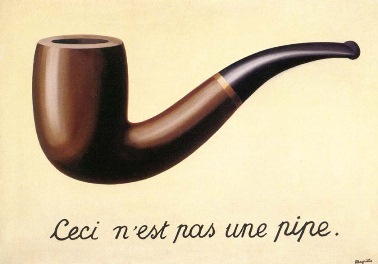
Which I feel was more than adequately boiled
down by Rene Magritte in his painting, The Treachery of Images (La
trahison des images, 1928–29), a painting of a pipe which he captions,
"Ceci n'est pas une pipe": “This is not a pipe.” And it isn’t. It’s a
painting of a pipe. “The famous pipe,” Magritte lamented. “How people
reproached me for it! And yet, could you stuff my pipe? No, it's just a representation,
is it not? So if I had written on my picture "This is a pipe," I'd
have been lying!” (Torczyner, Harry. Magritte: Ideas and Images. p. 71.)
 Taking this all further, Ebert noted about the
cinematic culture around him, “We may be leaving an age of irony and entering
an age of credulity. In a time of shortened attention spans and instant
gratification, trained by web surfing and movies with an average shot length of
seconds, we absorb rather than contemplate. We want to gobble all the food on
the plate, instead of considering each bite. We accept rather than select.”
Taking this all further, Ebert noted about the
cinematic culture around him, “We may be leaving an age of irony and entering
an age of credulity. In a time of shortened attention spans and instant
gratification, trained by web surfing and movies with an average shot length of
seconds, we absorb rather than contemplate. We want to gobble all the food on
the plate, instead of considering each bite. We accept rather than select.”Modern movies, from this point of view, are
neither self-contained nor created in a vaccuum. Every movie is made of
particles from other movies. “Homage” has moved beyond the in-joke, background
detail or set-piece and into literal and thematic presentation. So much of this
is personified by Quentin Tarantino and his contemporaries. They’re not making
movies, they’re making their versions of movies that had come before. “I told
Robert [Rodriguez], ‘You made your Fistful of Dollars with El
Mariachi, now’s the time to make your epic, your Once Upon a Time in the
West”, sez the world’s most successful fanboy on the audio commentary for Once
Upon a Time in Mexico. It’s like the self-referential humor of The
Family Guy: “That’s funny because I get it.” The Inglorious Basterds was
neither a remake of The Inglorious Bastards nor simply a World War II
adventure, but it was Tarantino’s WWII movie. Coming up is Tarantino’s
spaghetti western, Django Unchained.
For better or worse, we’re slowly coming out
of the age of irony and/or credulity because the most recent crop of
movie-goers, including but not limited to the Twi-hards, are simply unaware of
what came before, so every movie cliché is new to them. I remember a Twilight
fan swooning over Edward because, “When he says cheesy stuff, it’s sincere
because he doesn’t know it’s cheesy!” And thus we get Total Recall for
this generation, Red Dawn for this generation. And this generation
doesn’t know that they’re cheesy retreads, thus, they’re sincere.
All of this is a backhanded way of introducing
Ward Roberts new film, Dust Up, because it lands somewhere between
ironic and post-ironic. Produced through his Drexel Box production house, Dust
Up at first glance is a loving send-up of ‘70s exploitation, the
“grindhouse” genre that is all the rage. Ironic because it takes the
market-driven selling points of gratuitous sex, violence and mayhem and
embraces them. Post-Ironic because it takes the most ludicrous of these
elements to their logical conclusion. And post-credulous because it does it
with sincerity, honesty and a passion for all of the sources that came before
it. And in the end, Dust Up is not “Ward Roberts’ exploitation movie”; Dust
Up is Ward Roberts’ Dust Up. It takes all the other-movie particles
and molds them into something from his point of view and his sensibilities, and
those of his collaborators, and makes something that’s both familiar and
outrageous at the same time, but never seems derivative. It’s a balancing act
to be sure, and on either side of the tightrope lies disaster. Fortunately,
Roberts and company manage the middle walk very well.
Dust Up is about
the accidental—if not destined—collision of five people. New mom Ella and her
junkie husband Herman, and two opposing forces: the stoic and enigmatic
peaceful warrior Jack (Aaron Gaffney) and his Indian sidekick Mo (Devin Barry) on
one end; the twisted and gleefully evil narcissistic personality Buzz on the
other. Jack wears an eyepatch, a constant reminder of a tortured past as a
violent soldier; Mo wears a Jay Silverheels outfit and yellow-striped tube
socks, to both honor and mock his Native American forebears who have gotten
rich and fat off of casino living. Buzz (Jeremiah Birkett) ingests chemicals,
tortures people and declares everything to be his: “This is MY house. The House
of Buzz. In the Land of Buzz. In the Time of Buzz.”

Ella (Amber Benson) is a young mother living
in a house with severe plumbing problems. Her husband Herman (fellow filmmaker
Travis Betz), a roadie for Hoobastank (of all things), went a little loopy
after the birth of their daughter, Lucy, and is now holed up at Buzz’s in a
drug-induced, debt-heavy sabattacal. In need of clean water, Ella picks Jack’s
name out of the phone book—the way of this peaceful warrior is that of the
handyman. This is before Ella learns of her deadbeat spouse’s debt to
psychopath, Buzz. Actually, Buzz is much more than a psychopath, more than a
sociopath. He’s a charismatic, amoral, self-affirming bar owner-cum-cult leader
who promises those he doesn’t like—or happens to notice—with death via
dismantling at the hands of his chief thug, Mr. Lizard. What’s more amoral than
a sociopath? An anthropath, perhaps? Whatever, you don’t want to owe
money to Buzz.
You know what annoys Buzz more than being owed
money? Owing money to someone else. In this case, the corrupt, racist Sherriff
Haggler (The Hills Have Eyes remake’s Ezra Buzzington), who wants his
payoff and demands it in a most demeaning fashion. The laws of physics dictate
that shit rolls downhill, to Buzz calls in poor Herman’s marker, gives him 24
hours to get the money and then has Mr. Lizard eject him from the bar in a most
unfriendly fashion.
Over the course of a few scenes, Jack becomes
involved in Herman’s plight because it has become Ella’s plight. Jack is cut
from the same cloth as most wayward heroes on the path of
redemption—particularly Shane, according to an interview with Roberts at the Daily Grindhouse—so he isn’t likely to leave a damsel in distress. Before
you jump to conclusions, he’s doing this out of pure spirit. Yes, Herman is a
junkie, a bad husband, irresponsible, lazy, most likely unwashed and very much
an ungrateful jerk, but these facts aren’t lost on anybody. The deeper he drags
Jack (and Mo) into his pit of karmic despair, the more everyone—even
Buzz!—questions why they’re bothering to help him out at all. The lesson to be
taken away is if you’re going to be a selfish schlep of a person, you’d better
have a pretty and capable wife and an adorable baby at home. Otherwise even
Mother Theresa would be inclined to throw you to the wolves.

As can be expected, things spiral out of
control, epically and apocalyptically. Jack attempts to make good on Herman’s
debt by lending him half of the money he owes Buzz in a show of good faith, but
Buzz isn’t one to focus on problem-solving. In a matter of minutes, the casual
morning meeting results in Buzz accidentally blowing up his bar—it’s a Rube
Goldberg-esque chain of cause and effect, but the end result is that Buzz
accidentally shoots one of his meth chemists mid-cook and, as we all know, meth
is a most volatile and tempermental chemical potion. Emotionally, it’s the
fourteen-year-old-girl of drugs.
The rest of the film could be titled “Buzz’s
Bad Day”, as he punishes everyone in his path for his own misfortune. He and
reason aren’t even in the same time zone, and if you’re wondering if depravity
has a baseline, as far as Buzz goes, the answer is ‘no’. He does know how to
whip up a freak frenzy. Unfortunately, he doesn’t choose his followers wisely.
Drug-addled desert-scum aren’t known for their stamina, no matter how many
barbecued human bodies they’re fed. This is best demonstrated when Buzz
declares, “It’s orgy time!” and receives the same dismayed reaction as if he’d
announced a pop quiz.

Dust Up was
obviously crafted to be a fun time for all, and it’s one of the rare movies,
indie or otherwise, that is as much fun to watch as apparently it was to make.
Behind it all are smart filmmakers who know which conventions to turn on their
heads and which ones to embrace. As wacky as Dust Up is it never once
tries to act like it’s better than either the genre or its audience. Unlike
recent “grindhouse” movies like Hobo with a Shotgun, Dust Up wasn’t
designed as a party tray of excess and nihilism. It asks you to care about its
characters and then gives you characters to care about. Every one of the actors
is pitch-perfect in their performances so it’s hard to single any one out.
Gaffney’s a terrific hero archetype, violently opposed to violence lik Billy
Jack, but with the smooth vocal tones of Joel McCrea. Barry brings just enough
dry wit to Mo to comment on the insanity of things—even his own actions—without
becoming hipster about it all. As Herman, Travis Betz—whose amazing allegorical
demon cabaret, Lo (starring Birkett as the title character), introduced me to the majority of the versatile
cast—gives the jerk of a catalyst an affability that earns a little bit of
redemption at the end. Birkett doesn’t so much steal every scene he’s in as he
attempts to corner the market on it. Buzz could all too easily be a cartoon
villain, the word “Evil” given bushy eyebrows and pop eyeballs, but Birkett
hints at a humanity buried deep beneath the viciousness and drug-induced
paranoia. Both he and Jack project a loneliness and sense of loss, making them
each other’s dark mirror. Perhaps the hardest job was placed on Benson’s
shoulders. The filmmaker/author has the dubious honor of portraying the lone
sane person in this sea of multi-colored insanity. Like Bob Newhart in all
incarnations, she’s the only rational one in the room at any given time, and
she does it with a sense of humor that anchors all the madness together.
Roberts, Betz and Benson not only love film
but understand it as well, as they’ve proven through this movie and previous
offerings like Betz’s Joshua and Benson’s Drones (which she
co-wrote and directed with Adam Busch). They’re not into the popular mash-ups
of movie iconography and theme so much as they are into creating new forms from
previously-used clay. As far as Dust Up goes, Roberts has taken the
history of movies he loves and built upon it, rather than attempt to reflect it
in some mirror he fractured himself. The result is both familiar to those who
know the territory and unique at the same time. A ‘70s sex ‘n death-fest with
an altruistic attitude taken from Howard Hawks westerns. A salute to what came
before even as it moves forward.
As the saying goes, “This is Dust Up.
There are others like it, but this one is…” Roberts’, Drexel Box’s, and now
ours.

